
Wisdom Teeth Recovery Timeline: Day by Day Healing After Removal
A wisdom teeth recovery timeline shows how healing usually moves from the day of surgery to the point where you feel normal again. Most people rest for the first two days, reach peak swelling on day 2 or 3, feel clearly better between days 4 and 7, and are close to normal within one to two weeks. The gum and bone under each socket keep healing quietly for weeks after that.
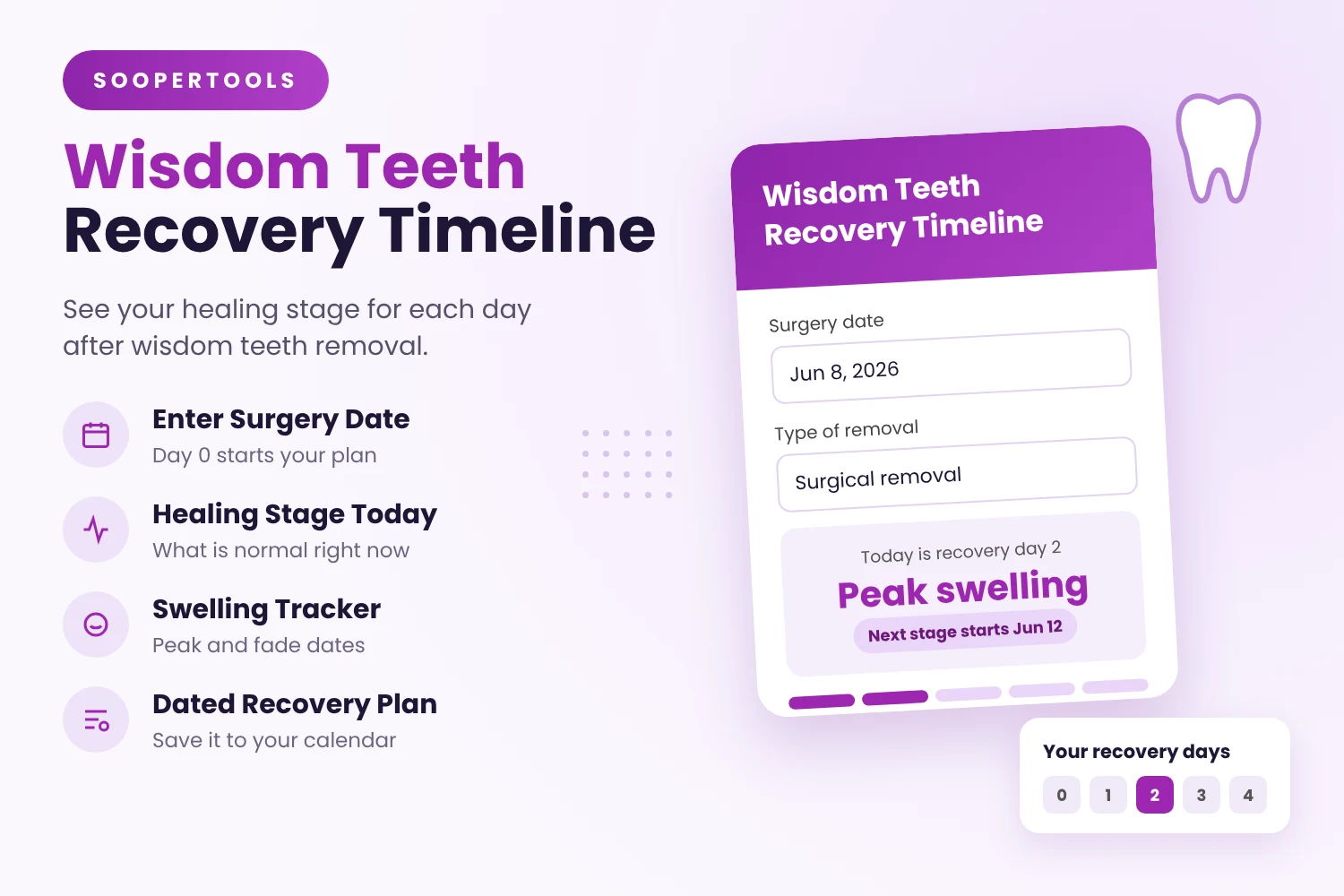
The tool above turns those stages into real calendar dates based on your own surgery day, so you can see where you are today and plan the week ahead.
Quick Answer: The Wisdom Teeth Recovery Timeline
In short, the wisdom teeth recovery timeline looks like this. Days 0 to 1 are for rest and protecting the blood clot. Swelling usually peaks on days 2 to 3. It then goes down over days 4 to 7, and most people are back to work or school in that window. By the end of the second week most swelling and soreness have gone, while the gum closes over the next few weeks.
The HSE says full recovery can take up to two weeks. Your own surgeon's instructions always come first.
How the Wisdom Teeth Recovery Timeline Works
The wisdom teeth recovery timeline tool asks for two things. The first is the date of your surgery, which counts as Day 0. The second is the type of removal. A simple removal means the teeth had fully come through the gum. A surgical removal means the teeth were impacted, so the surgeon had to open the gum or remove some bone.
From the date, the tool works out your recovery day and places you in one of five healing stages. For that stage it shows what is normal, how swelling usually behaves, care steps for today, what to avoid and the date the next stage begins.
The removal type changes one thing, the estimated return to most daily activities. That estimate is day 4 for a simple removal and day 7 for a surgical one. The stage dates stay the same for both, because the main healing steps follow the same order.
You can copy the plan, print it, download it as a text file, add every stage to your calendar or copy a link that reopens the same timeline. Your last date is also saved on this device, so the timeline updates for today when you come back.
Wisdom Teeth Removal Recovery, Stage by Stage
The table shows the five stages of wisdom teeth removal recovery that the tool uses. Treat each start day as a typical point, not a deadline.
| Stage | Days | What usually happens | Swelling |
|---|---|---|---|
| 1. Rest and clot protection | Day 0 to 1 | Light oozing, numbness wearing off, soreness. A blood clot forms in each socket. | Starting to build |
| 2. Peak swelling | Days 2 to 3 | Puffy cheeks, jaw stiffness and possible bruising. Often the hardest days. | Usually at its peak |
| 3. Swelling going down | Days 4 to 7 | Pain and swelling ease each day. The mouth opens wider. | Going down |
| 4. Soft tissue healing | Days 8 to 14 | Gum starts closing over the sockets. Dissolving stitches fall out. | Mostly gone |
| 5. Final healing | Day 15 and later | Most people feel normal. Gum and bone keep filling in for weeks to months. | Gone for most people |
Days 0 and 1
The first day is about keeping the blood clot in place. Bite on gauze as your surgeon showed you and rest with your head raised. Avoid rinsing, spitting, straws and smoking, because suction and pressure can loosen the clot. The straw after wisdom teeth removal checker and the smoking after wisdom teeth removal checker give dated answers for those two habits. If bleeding continues, the NHS advises pressing firmly on the area for at least 10 minutes with a clean, folded cloth or cotton wool.
Days 2 and 3
Many people feel worse on day 2 or 3 than on day 1. That is normal. The LSU oral surgery department notes that swelling peaks on the third day and can take five to seven days to settle. Gentle warm salt water rinses usually start after the first 24 hours.
Days 4 to 7
This is when wisdom teeth removal recovery speeds up for most people. You can walk, read and work at a desk, and many people go back to work or school during this week. Pain that grows instead of fading after day 3 is not part of the normal pattern and needs a call to your surgeon.
The second week and beyond
Stitches that dissolve tend to fall out during the first one to two weeks. Our guide on wisdom teeth stitches explains what to expect. The sockets close more slowly than the pain fades, and the wisdom teeth holes healing timeline follows that part in detail.
Food changes along the way too. The wisdom teeth food timeline covers what to eat on each day, and the drink checker covers drinks.
How Long Does Swelling Last After Wisdom Teeth Removal?
So how long does swelling last after wisdom teeth removal? For most people, swelling builds over the first day, peaks between 48 and 72 hours, and then goes down over the rest of the first week. The HSE notes that facial bruising and swelling can last 7 to 10 days, and that bruising around the jaw can last up to two weeks.
Cold packs help most in the first 24 hours. Use them in short sessions of about 20 minutes on and 20 minutes off. After that, some surgeons suggest warm, moist compresses to ease stiffness, while others prefer you wait until the swelling has peaked. Use the method your surgeon gave you.
Sleeping with your head raised also helps fluid drain away from the face. Our guide on how to sleep after wisdom teeth removal has practical positions for the first nights.
How Long Does It Take for Wisdom Teeth to Heal?
If you are asking how long does it take for wisdom teeth to heal, there are two answers, because healing happens on two levels. How you feel improves fast. Guy's and St Thomas' NHS Foundation Trust gives an average recovery of 3 to 7 days, with jaw stiffness for about 3 to 4 days.
The tissue under the surface takes longer. The gum usually closes over the sockets in the weeks after surgery, and the bone underneath fills in over several months. That is why a small hole can still be visible after you feel completely normal. It does not mean something is wrong.
So when people ask how long it takes for wisdom teeth to heal, the practical answer is about one to two weeks to feel normal and a few months for the jawbone to finish.
How to Care for Wisdom Teeth Sockets While They Heal
These steps show how to care for wisdom teeth sockets during the first week, when the clot is most fragile.
- Protect the clot on day 0. No rinsing, spitting or straws for the first 24 hours.
- Rinse gently after 24 hours. Mayo Clinic advises gentle salt water rinses every two hours and after meals for a week, starting 24 hours after surgery. Let the water fall out of your mouth instead of spitting hard.
- Brush your other teeth. Keep brushing, but be careful near the sockets. The brushing after wisdom teeth removal checker explains what to do on each day.
- Rest, then move. Rest for the first two days. Light walks are fine after that. Mayo Clinic suggests avoiding strenuous activity for at least a week.
- Keep follow-up visits. The HSE mentions a check-up about a week later, when any stitches that do not dissolve are removed.
Learning how to care for wisdom teeth sockets well in the first week is the best way to keep your recovery on track.
Why Recovery Times Differ Between People
You will find guides that say recovery takes three days and others that say two weeks. Both can be right. Your wisdom teeth removal recovery depends mostly on the surgery itself. Removing teeth that have fully come through is usually quicker to recover from than removing impacted teeth that need a cut in the gum or bone removal.
The number of teeth removed, your age, smoking and how closely you follow aftercare advice also play a part. This is why the tool asks for the type of removal and uses a later return date for surgical cases. If you are planning ahead, our guide on how long wisdom teeth removal takes covers the day of the procedure.
When to Contact Your Dentist or Surgeon
Some pain, swelling and stiffness are expected during wisdom teeth removal recovery. Contact your dentist or oral surgeon if you notice any of the following.
- Severe pain, or pain that gets worse after the third day
- Bleeding that does not slow down with firm pressure
- A fever
- Swelling that keeps growing after the third day
- Trouble swallowing or breathing
- Numbness that has not faded after the first day
The tool cannot see how your mouth is healing. It only shows the typical pattern.
Wisdom Teeth Recovery Timeline Examples
Example 1: Day 2 After a Surgical Removal
Surgery date: Monday, June 8, 2026. Today: Wednesday, June 10, 2026. Type: Surgical removal.
Result: Recovery day 2, stage "Peak swelling", with swelling usually at its peak. The next stage, swelling going down, starts on Friday, June 12 (day 4). A typical return to most daily activities is around Monday, June 15 (day 7).
At this point the wisdom teeth recovery timeline suggests resting, sleeping with your head raised and starting gentle warm salt water rinses after meals.
Example 2: Day 10 After a Simple Removal
Surgery date: Monday, June 8, 2026. Today: Thursday, June 18, 2026. Type: Simple removal.
Result: Recovery day 10, stage "Soft tissue healing" (June 16 to June 22), with swelling mostly gone. The final stage starts on Tuesday, June 23 (day 15). Most people with a simple removal are back to daily activities by day 4, which was Friday, June 12.
The wisdom teeth recovery timeline reminds you to keep the sockets clean after meals and to ease back into exercise only if your surgeon agrees.
Frequently Asked Questions
Either can feel the worst, because swelling usually peaks between 48 and 72 hours. From day 4 most people notice steady improvement. If pain gets worse after day 3, contact your surgeon.
Many people need one to three days for a simple removal and closer to a week after surgical removal, especially for physical jobs. The HSE suggests one to two days off if your dentist recommends it. The tool gives a typical date based on your type of removal.
Swelling usually peaks on day 2 or 3 and goes down over the following days. Most visible swelling has gone within about a week, although bruising can take up to two weeks to fade.
Most people feel normal within one to two weeks. The gum closes over the following weeks and the bone fills in over several months, so the sockets take longer than the soreness.
Light walks are usually fine after the first couple of days. Mayo Clinic suggests avoiding strenuous activity for at least a week. The exercise after wisdom teeth removal checker gives a dated answer.
Cold packs help most in the first 24 hours. Some surgeons then suggest warm, moist compresses, while others wait until swelling has peaked. Follow the timing your surgeon gave you.
Always follow your surgeon's instructions. They know how your surgery went. The wisdom teeth recovery timeline shows the typical pattern to help you plan your days.
Most wisdom teeth removal recovery takes about one week to feel mostly normal and up to two weeks for swelling, bruising and stiffness to settle fully. Surgical removal of impacted teeth usually sits at the longer end of that range.
References
- NHS. Wisdom tooth removal recovery. Bleeding control and when to get help.
- HSE (Ireland). Recovery after wisdom tooth removal. Full recovery up to two weeks, swelling and bruising for 7 to 10 days.
- Guy's and St Thomas' NHS Foundation Trust. Recovering from wisdom tooth surgery. Average recovery of 3 to 7 days and jaw stiffness.
- Mayo Clinic. Wisdom tooth extraction. Salt water rinses and activity after surgery.
- LSU Oral and Maxillofacial Surgery. Instructions after wisdom tooth removal. Swelling peaks on the third day.
Written by SooperTools Editorial Team
Content last updated November 18, 2026