
CD Ladder Emergency Fund
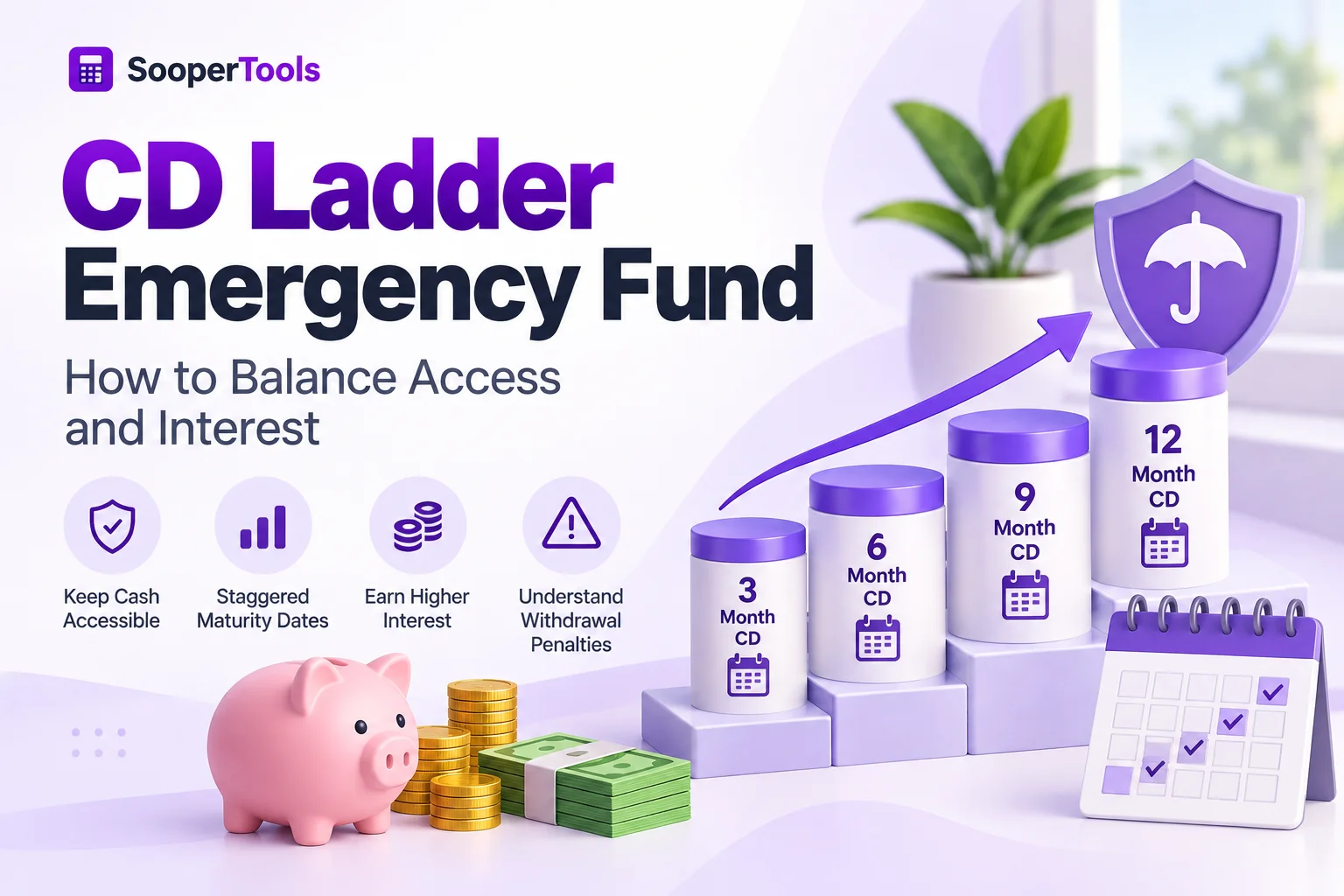
Table of Contents
CD Ladder Emergency Fund: How to Balance Access and Interest
A CD ladder emergency fund can help you earn interest on part of your savings while arranging for portions of that money to mature at different times. However, a traditional certificate of deposit (CD) may charge a penalty if you withdraw money before maturity. For that reason, a CD ladder is generally more suitable as a possible supplement to readily accessible emergency savings than as a complete replacement for cash you might need immediately.
The key decision is how to balance accessibility with interest earnings. Before putting emergency savings into CDs, consider your essential expenses, income stability, likely unexpected costs, and the amount you could need at short notice. A carefully structured plan should leave enough money accessible for immediate needs and place only an appropriate portion into CDs with staggered maturity dates.
Key point: A CD ladder creates scheduled maturity dates, not guaranteed immediate access to all your savings. Keep an accessible reserve for urgent expenses and understand the withdrawal terms of every CD before committing your money.
Can You Use a CD Ladder for an Emergency Fund?
Yes, a CD ladder may be useful for part of an emergency fund when you already have sufficient readily accessible savings and can afford to leave the money in CDs until they mature. It can be less suitable when your income is unpredictable, your immediate expenses are difficult to cover, or you may need most of the money without warning.
The Consumer Financial Protection Bureau (CFPB) explains that an emergency fund is money set aside for unplanned expenses, such as car repairs, medical bills, home repairs, or lost income. It also notes that the amount needed depends on an individual’s circumstances. Its guidance on building an emergency fund is a useful starting point when deciding how much to keep available.
A traditional savings account and a CD serve different purposes. A savings account generally provides more convenient access to money, while a CD requires you to commit funds for a specified term. A ladder combines multiple CD terms, but it does not remove the restrictions of the individual accounts.
When a CD Ladder May Make Sense
- You already have an accessible reserve for urgent bills and short-term disruptions.
- A portion of your savings is unlikely to be needed before its CD matures.
- You want to spread maturity dates instead of putting all eligible savings into one long-term CD.
- You are willing to monitor maturity dates, renewal instructions, and changing account terms.
When It May Not Be Appropriate
- You do not yet have enough readily accessible savings to cover likely emergencies.
- Your income varies considerably and you may need substantial amounts at short notice.
- You expect to use the money for planned expenses before the CDs mature.
- An early-withdrawal penalty would create an additional financial problem during an emergency.
The decision is not simply whether CDs pay more interest than a savings account. It is whether the additional return on the money placed in CDs justifies the loss of flexibility for your circumstances.
How Much of Your Emergency Fund Should Stay Liquid?
The appropriate amount to keep liquid depends on your essential monthly expenses, income reliability, existing cash reserves, and access to other resources. There is no single cash-to-CD percentage that works for every household.
Start by identifying the expenses you would need to pay if your income stopped or an unexpected bill arrived. These may include housing, utilities, groceries, insurance, transportation, minimum debt payments, and necessary medical costs. Consider how quickly you might need to pay them and whether another reliable source of funds would be available.
For many people, keeping an accessible reserve first is more important than maximizing the interest earned on every dollar. The reserve should be adequate for the risks and expenses you expect to manage before a CD reaches maturity.
Questions to Ask Before Placing Savings Into CDs
- How much do I need for an urgent bill that is due today or this week?
- How long could I manage essential expenses if my regular income stopped?
- Are my employment income and other cash inflows predictable?
- Could a major repair or medical bill exceed my immediately accessible reserve?
- Would I have to break a CD if two unexpected expenses occurred close together?
Your answers help establish how much money can reasonably be committed to CDs. If you are still building an emergency fund, it may be more practical to prioritize accessible savings before adding a CD ladder.
How to Structure a CD Ladder for Emergency Savings
An emergency fund CD ladder usually divides the portion allocated to CDs into separate deposits with different maturity dates. The aim is to create planned opportunities to access or reinvest money without locking the entire CD allocation into one maturity date.
For example, a four-rung ladder might use three-month, six-month, nine-month, and twelve-month CDs. If all four CDs are opened at the same time, their initial maturity dates will be spread across the first year. After the first CD matures, reinvesting it into a new longer-term CD may help establish a repeating schedule of future maturities, provided the saver does not need the proceeds.
| CD rung | Illustrative term | Initial maturity | Main consideration |
|---|---|---|---|
| Rung 1 | 3 months | About 3 months after opening | Earliest scheduled CD access |
| Rung 2 | 6 months | About 6 months after opening | Next planned maturity |
| Rung 3 | 9 months | About 9 months after opening | Later access point |
| Rung 4 | 12 months | About 12 months after opening | Longest initial term in this example |
This schedule is an illustration, not a recommendation that everyone should use these exact maturities. A shorter or longer schedule may be more appropriate depending on the money allocated to CDs, the available offers, account minimums, and the time horizon for which the funds can remain untouched.
Also remember that a maturity date is not necessarily the same as having money available in your checking account instantly. Check the financial institution’s maturity processing, transfer timing, grace period, and automatic-renewal rules before relying on a CD for a particular payment.
For a broader explanation of the strategy, see the CD ladder guide. It covers the general structure without changing the central priority of keeping emergency funds accessible when needed.
Example: Combining Liquid Savings With a CD Ladder
The following example shows how an emergency fund might be divided between an accessible account and a CD ladder. The amounts are hypothetical and are provided only to demonstrate the structure. They are not a recommended allocation for every household.
Illustrative $12,000 Emergency Reserve
| Reserve component | Amount | Purpose |
|---|---|---|
| Accessible savings account | $6,000 | Money available for immediate or near-term expenses, subject to account access and transfer arrangements |
| 3-month CD | $1,500 | First planned CD maturity |
| 6-month CD | $1,500 | Second planned CD maturity |
| 9-month CD | $1,500 | Third planned CD maturity |
| 12-month CD | $1,500 | Fourth planned CD maturity |
| Total | $12,000 | Accessible reserve plus four CD deposits |
In this example, half of the reserve remains in an accessible savings account and the other half is divided across four CDs. This does not mean that a 50/50 allocation is right for everyone. If $6,000 is insufficient for the household’s immediate needs, the CD portion should not be treated as readily available cash.
What Happens as the CDs Mature?
When the first CD matures, the saver can decide whether to withdraw the proceeds or reinvest them. If the money is still needed for emergency reserves, it can remain accessible rather than being automatically committed to another CD. If the reserve is adequate and the money can remain untouched, reinvestment may preserve the ladder structure.
After the ladder has been established and a maturing deposit is repeatedly reinvested into an appropriate longer term, the saver may develop recurring maturity dates. The actual schedule depends on the original maturity dates, the selected renewal terms, and whether matured funds are withdrawn instead.
Do not assume that the original APY will be available for a renewed CD. Compare current offers when a maturity date approaches, and review the account’s automatic-renewal rules before making a decision.
You can use the CD Ladder Calculator to model a proposed schedule and estimate returns using your own assumptions. A calculator can help organize the scenario, but it cannot predict future rates or decide how much money you will need during an emergency.
What Happens If You Need Money Before a CD Matures?
If an emergency occurs before a traditional CD reaches maturity, withdrawing the money early may trigger a penalty. The specific cost depends on the account’s terms. You should not assume that every institution uses the same penalty formula or that an early withdrawal will have the same effect on every CD.
The CFPB explains that a CD generally requires you to leave the deposit in the account for the agreed term and that an early withdrawal usually means paying a penalty. Its guide to certificates of deposit recommends comparing the term, interest rate, and early-withdrawal penalty when shopping for a CD.
Options to Consider if an Emergency Occurs
- Use accessible emergency savings first. If those funds can cover the expense without compromising other urgent needs, you may not have to withdraw a CD early.
- Review the CD agreement. Confirm the penalty, withdrawal process, and expected timing before requesting early access.
- Check whether the account allows penalty-free access under specific conditions. Do not assume such an exception exists; confirm it in the actual account terms.
- Evaluate a no-penalty CD for future allocations. Some products offer withdrawal flexibility under specified conditions, but terms and rates differ. This does not eliminate the need for accessible emergency savings.
If you need to investigate a potential withdrawal cost, use the CD Early Withdrawal Penalty guide for the general explanation and the CD Early Withdrawal Penalty Calculator to estimate a specific scenario. Verify the result against the institution’s actual agreement before acting.
How to Decide Whether a CD Ladder Fits Your Emergency Fund
Before opening the CDs, use a simple decision process. It can help you avoid committing money that you may need before maturity.
- Estimate your accessible reserve needs. Consider essential expenses, likely emergencies, income stability, and the time required to obtain additional funds.
- Separate money by time horizon. Keep the amount needed for immediate and near-term expenses accessible. Consider CDs only for the portion that can remain committed for the agreed terms.
- Compare the available CD terms. Check APY, minimum deposits, maturity dates, early-withdrawal penalties, and renewal conditions.
- Choose maturity spacing. Pick intervals that fit your expected needs rather than choosing terms only because they fit a conventional ladder example.
- Review the arrangement periodically. If your essential costs rise, your income becomes less predictable, or you use a significant part of your reserve, reconsider whether the existing CD allocation is still suitable.
Keep in mind that deposit insurance and liquidity are different issues. Eligible deposits at an FDIC-insured bank are generally insured up to the applicable limit, but insurance does not mean a CD can be withdrawn before maturity without a penalty. The FDIC explains its coverage rules in its guide to understanding deposit insurance.
What Do Reddit Discussions Say About CD Ladder Emergency Funds?
People searching for cd ladder emergency fund reddit may encounter personal stories from savers who use CD ladders as part of their emergency reserves. These discussions can help surface practical concerns, such as how often CDs mature, whether a separate savings account is necessary, and what happens when money is needed unexpectedly.
However, a personal account does not establish that the same strategy is suitable for every household. Someone with stable income, low essential expenses, and other available funds may accept restrictions that would be risky for someone who has irregular income or limited savings. Evaluate the circumstances behind any recommendation rather than copying another person’s maturity schedule or allocation.
The most useful question is not whether a ladder worked for another saver. It is whether your accessible reserve could cover realistic emergencies without requiring you to withdraw a CD prematurely.
Related Tools
These tools can help you model a CD schedule and understand the potential cost of accessing a deposit before maturity. Use your actual account terms when interpreting any estimate.
- CD Ladder Calculator — Model different CD terms and estimate returns based on your selected deposit amounts and rates.
- CD Early Withdrawal Penalty Calculator — Estimate a possible penalty for an early withdrawal using the relevant assumptions.
Frequently Asked Questions
1. Is a CD ladder a good idea for an emergency fund?
A CD ladder may suit part of an emergency fund if you already have adequate accessible savings and can leave the CD deposits untouched until maturity. It may be unsuitable as the sole emergency reserve because an unexpected expense can occur before a CD matures.
2. How much of my emergency fund should go into CDs?
There is no universal percentage. Base the decision on your essential expenses, income reliability, likely unexpected bills, and other available resources. Keep enough accessible to cover plausible immediate needs before committing any remaining amount to CDs.
3. How often should emergency-fund CDs mature?
The maturity interval should reflect your cash needs and the amount you can leave invested. A shorter interval may provide more frequent scheduled access but can involve different rates and account terms. Select a schedule that fits your situation rather than following a fixed interval automatically.
4. What if I need my money before a CD matures?
You may have to pay an early-withdrawal penalty under the CD’s contract. Check the account agreement for the penalty and withdrawal process. This risk is one reason to maintain accessible emergency savings outside traditional CDs.
5. Can I use a no-penalty CD for emergency savings?
A no-penalty CD may offer more flexibility under its specific terms, but access conditions, rates, and withdrawal procedures vary. Read the contract carefully and keep a separate accessible reserve for needs that cannot wait for the account’s withdrawal process.
6. Should I reinvest a CD that matures?
Reinvest only after checking whether the matured funds are still surplus to your emergency needs. If your accessible reserve is too low or your circumstances have changed, keeping the proceeds liquid may be more appropriate than renewing the CD. Compare current offers and renewal rules before reinvesting.
7. Are Reddit recommendations enough to choose an emergency-fund CD ladder?
No. Reddit discussions can reveal real-world questions and experiences, but an individual’s circumstances may differ from yours. Check the CD’s actual contract, compare accessible savings options, and decide whether the proposed schedule fits your own cash needs.
Final Considerations
A CD ladder can be one component of an emergency-savings plan when the money placed into CDs is not needed immediately. The most important step is to protect access to the funds you may need unexpectedly, then consider staggered CDs for the portion you can reasonably commit for specified terms.
Review the structure as your finances change, verify each CD’s withdrawal and renewal rules, and use calculations as estimates rather than guarantees. The right balance is the one that allows you to manage an emergency without creating a larger problem by making essential money difficult or costly to access.
References
- Consumer Financial Protection Bureau: An Essential Guide to Building an Emergency Fund
- Consumer Financial Protection Bureau: What Is a Certificate of Deposit?
- Federal Deposit Insurance Corporation: Understanding Deposit Insurance
This article is for general educational purposes only and is not individualized financial advice. Account terms, access rules, interest rates, and withdrawal penalties vary by institution. Verify the applicable conditions before making a financial decision.