
CD Ladder vs Bond Ladder
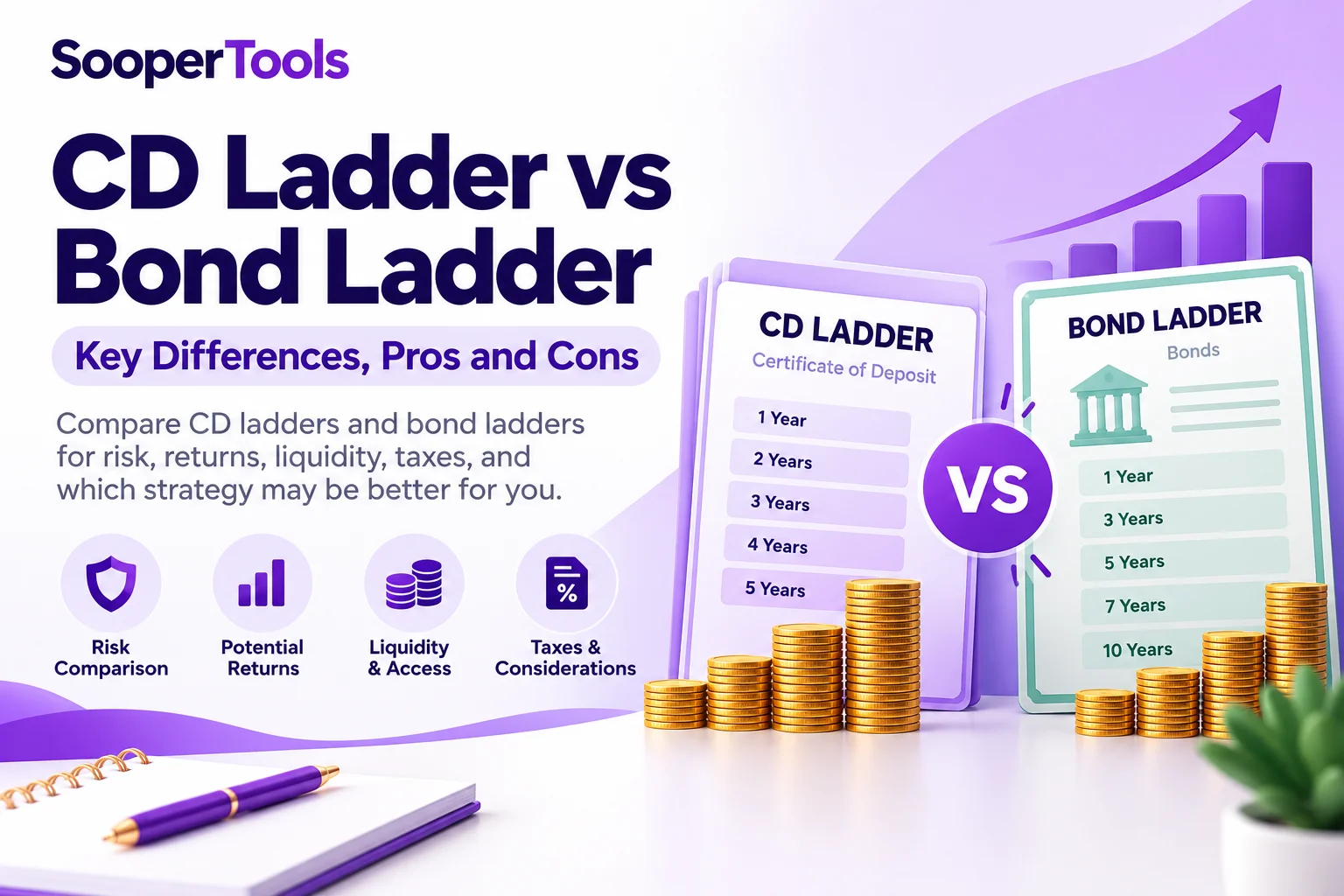
Table of Contents
CD Ladder vs Bond Ladder: Key Differences and How to Choose
A CD ladder and a bond ladder both spread investments across different maturity dates, but they work differently when it comes to deposit insurance, market risk, income, liquidity, and taxes. A CD ladder may suit someone who values predictable deposit terms and wants to avoid selling investments on the market. A bond ladder may offer more flexibility in choosing issuers, maturities, and income schedules, but its risks depend on the bonds selected. The right choice depends on when you need your money, how much risk you can accept, and which investments fit your financial goals.
Key point: Eligible bank CDs can receive FDIC deposit insurance within applicable limits, while bonds are investments rather than FDIC insured deposits. Individual bonds can also lose market value before maturity. Treasury securities have different protections because they are backed by the United States government, not insured by the FDIC.
What Is a CD Ladder?
A certificate of deposit, or CD, is a bank deposit held under specific terms for an agreed period. The bank generally pays interest according to the CD agreement. If you withdraw money from a traditional CD before maturity, the bank may charge an early withdrawal penalty.
A CD ladder divides money among several CDs with different maturity dates. Instead of putting the entire amount into one long term CD, you spread it across shorter and longer terms. As each CD matures, you can use the money or reinvest it in another CD.
For example, a ladder might contain one year, two year, three year, four year, and five year CDs. As the earliest CD matures, you decide whether to spend the proceeds or buy a new five year CD, depending on your goals and the available terms.
The main purpose is to create staggered opportunities to access money while maintaining exposure to different interest rates and maturity periods. The actual interest earned depends on each CD’s APY, term, balance, and interest payment terms.
For a fuller explanation of the strategy, see the SooperTools guide to building and managing a CD ladder.
What Is a Bond Ladder?
A bond ladder is a portfolio of individual bonds with different maturity dates. Rather than buying bonds that all mature at the same time, you spread the investment across several dates so that principal repayments occur at intervals.
A bond ladder can contain US Treasury securities, corporate bonds, municipal bonds, or a combination of eligible securities. These investments have different credit risks, interest payment schedules, tax treatments, and liquidity characteristics.
Many conventional fixed rate bonds pay interest periodically, often every six months, although the schedule depends on the security. When an individual bond matures, the issuer is generally obligated to repay its principal according to the bond terms, subject to the issuer meeting its obligations.
Bond prices can change before maturity. If market interest rates rise, an existing fixed rate bond may become less attractive relative to newly issued bonds, which can reduce its market price. Selling before maturity can therefore produce a gain or loss.
For official information about these risks, consult the SEC’s explanation of selling bonds before maturity.
CD Ladder vs Bond Ladder: Side by Side Comparison
The following table compares the general characteristics of a bank CD ladder with a ladder made from individual bonds. Actual terms vary by institution, issuer, security, and account arrangement.
| Feature | CD ladder | Bond ladder |
|---|---|---|
| Investment type | Bank deposits with stated terms and interest conditions. | Debt securities issued by governments, municipalities, or companies. |
| Protection | Eligible CDs at FDIC insured banks may receive deposit insurance within applicable limits and ownership rules. | Depends on the issuer and security. Treasury securities are backed by the US government, but bonds are not FDIC insured. |
| Return calculation | Usually evaluated using the CD’s APY, term, principal, and interest terms. | Evaluated using factors such as purchase price, coupon, yield to maturity, fees, and holding period. |
| Interest payments | May be paid periodically or at maturity, depending on the CD agreement. | Depends on the bond. Many conventional fixed rate bonds pay coupons periodically. |
| Early access | Traditional CDs may impose early withdrawal penalties. Brokered CDs can have different resale arrangements. | Individual bonds can often be sold through a brokerage, but the sale price may be above or below the purchase price. |
| Market price changes | A traditional bank CD generally does not trade daily on a secondary market. | Market prices fluctuate as interest rates, issuer credit conditions, and market demand change. |
| Issuer risk | Depends on the institution and applicable deposit insurance coverage. | Depends on the bond issuer, credit quality, and terms. Corporate and municipal bonds carry different credit risks. |
| Tax treatment | Interest is generally taxable, with the details depending on applicable tax rules. | Depends on the bond type. Treasury interest is generally federally taxable but exempt from state and local income taxes. |
| Common use | Staggered savings with defined deposit terms and planned maturity dates. | Staggered fixed income investments with flexibility to select different issuers and securities. |
Deposit insurance, investment risk, tax treatment, and liquidity depend on the actual product and account. Review the applicable terms before investing.
Which Is Safer: A CD Ladder or a Bond Ladder?
Neither label alone tells you how much risk an investment carries. The comparison depends on the CD institution, the type of bond, the amount invested, the holding period, and whether you might need to sell before maturity.
CD ladder safety and deposit insurance
Eligible CDs held at FDIC insured banks can receive FDIC insurance. The standard limit is $250,000 per depositor, per insured bank, for each account ownership category. The limit generally applies to the combined eligible deposits in the same ownership category at that bank, not separately to every CD.
This means dividing a large balance into multiple CDs at the same bank does not automatically provide additional coverage. Before building a ladder, check which bank issued each CD, how your accounts are titled, and how your balances are aggregated for insurance purposes. Credit union share certificates may instead qualify for coverage under the applicable National Credit Union Administration rules.
Deposit insurance protects eligible deposits subject to its rules. It does not protect every product called a CD, guarantee that every advertised return is appropriate, or eliminate early withdrawal restrictions.
Bond ladder safety and market risk
Bond risks depend on the security. A US Treasury security has the backing of the United States government for payment under its terms. A corporate bond depends on the issuing company’s ability to meet its obligations. Municipal bonds also have issuer specific credit risks and different tax considerations.
Even a Treasury bond can fall in market value when interest rates rise. If you hold an individual bond until maturity and the issuer pays as promised, its price fluctuations before maturity may be less important to your final principal repayment. However, an unexpected need to sell may force you to accept a lower price.
A bond ladder is not automatically riskier than a CD ladder in every situation. For example, a ladder made of Treasury securities has a different credit risk profile from a ladder of lower rated corporate bonds. Compare the actual investments rather than relying on the general category alone.
Liquidity: How Quickly Can You Access Your Money?
Liquidity is one of the most important differences to examine when deciding between a CD ladder and a bond ladder.
Accessing money in a CD ladder
A traditional CD generally pays its stated return according to its terms when held to maturity. If you need money earlier, the issuing bank may permit an early withdrawal but impose a penalty. The penalty may reduce the interest you receive, and some contracts set additional conditions.
Brokered CDs require separate consideration. Their resale terms differ from those of traditional bank CDs. A brokered CD may be sold in a secondary market, but its price can be lower than the purchase price, and a sale may not be available on the terms you expect.
For this reason, a CD ladder should not be treated as a direct replacement for cash that must be available immediately. Keep enough money in an appropriate liquid account for near term expenses and emergencies.
Accessing money in a bond ladder
Individual bonds can often be sold before maturity through a brokerage. The amount you receive depends on the market price, accrued interest, transaction costs, and availability of buyers. A sale could return more or less than your original investment.
A ladder of actively traded Treasury securities may be easier to sell than some less frequently traded corporate or municipal bonds, but market liquidity varies. A bond that can technically be sold is not necessarily one that can be sold at a favorable price.
If your priority is predictable access to a fixed amount on a specific date, compare the maturity schedule and early access conditions rather than assuming that one ladder is always more liquid.
Income, Interest Rates, and Return Comparisons
A bond ladder versus CD comparison should use comparable terms and realistic estimates, not just the highest advertised interest rate.
Understand APY and bond yield
For a CD, the annual percentage yield, or APY, reflects the effect of compounding over a year under the product’s stated assumptions. The actual dollar interest depends on the amount invested, the term, payment arrangements, and whether the money remains invested as planned.
For a bond, yield to maturity estimates the annualized return associated with the purchase price, contractual payments, and principal repayment at maturity. It differs from the coupon rate, which is the interest rate used to calculate the bond’s scheduled coupon payments based on its stated principal.
Yield to maturity is not a guarantee of the return you will realize if you sell early. Actual outcomes can differ because of sale prices, transaction costs, payment defaults, and other conditions. Any comparison should also account for taxes and the effect of reinvesting payments when relevant.
What happens when interest rates change?
When rates rise, newly issued CDs may offer better APYs than an existing CD, depending on the market and the terms offered by banks. A CD ladder allows maturing funds to be reconsidered at those newer rates, but it does not automatically secure the highest available rate.
Existing fixed rate bonds may decline in market value when comparable market yields rise. If held to maturity and the issuer meets its obligations, the contractual cash flows remain governed by the bond terms. If sold before maturity, the investor may realize a loss or gain.
When rates fall, maturing CDs may need to be reinvested at lower APYs. Existing bonds with higher coupon rates may become more valuable in the market, although the outcome depends on the specific bond and market conditions.
Neither ladder removes reinvestment risk. Both require decisions when maturities arrive, and future rates cannot be known with certainty.
How Do Taxes Differ Between CD and Bond Ladders?
Tax treatment can influence the value of the interest you retain, but the result depends on the investment type, your tax situation, and applicable law.
- Bank CD interest: Generally subject to federal income tax and usually state and local income taxes where applicable.
- US Treasury securities: Interest is generally subject to federal income tax but exempt from state and local income taxes.
- Municipal bonds: Interest may qualify for federal tax exemption, but the rules and any state tax benefits depend on the security and the taxpayer’s circumstances.
- Corporate bonds: Interest is generally taxable, and treatment can vary for particular instruments or transactions.
Do not compare a CD’s quoted APY directly with a bond’s yield and assume that the higher figure always leaves more money after tax. Consider the applicable federal and state rules, fees, maturity, and other investment characteristics.
The IRS Publication 550 on investment income and expenses explains tax treatment for many investment income types. Tax treatment for specific securities and personal circumstances may require professional guidance. Consult a qualified tax professional when the amount or complexity of the investment makes personalized guidance important.
Example: Building a Five Rung Ladder
Illustrative $25,000 investment
Suppose an investor has $25,000 available for a ladder and chooses to divide it into five equal portions of $5,000. The investor wants maturity dates spread across five years rather than having the entire amount mature at once.
| Rung | Illustrative allocation | CD ladder approach | Bond ladder approach |
|---|---|---|---|
| 1 | $5,000 | CD selected to mature in year 1. | Individual bond selected with an appropriate year 1 maturity. |
| 2 | $5,000 | CD selected to mature in year 2. | Individual bond selected with an appropriate year 2 maturity. |
| 3 | $5,000 | CD selected to mature in year 3. | Individual bond selected with an appropriate year 3 maturity. |
| 4 | $5,000 | CD selected to mature in year 4. | Individual bond selected with an appropriate year 4 maturity. |
| 5 | $5,000 | CD selected to mature in year 5. | Individual bond selected with an appropriate year 5 maturity. |
This example illustrates the structure, not a forecast of investment returns. Actual minimum investments, available maturities, rates, bond prices, coupon schedules, and fees depend on the products selected.
When the first CD matures, the investor can use the proceeds or reinvest them in a new CD. In the bond ladder, the investor receives the contractual payments on the first bond and can decide whether to spend the maturity proceeds or purchase another bond.
The two strategies can therefore create similar maturity patterns without producing identical cash flows. Bond coupon payments may provide income before maturity, while a CD’s interest payment schedule depends on its agreement.
If you want to estimate CD ladder terms and maturities, the SooperTools CD ladder calculator can help model the CD side. It does not calculate the market value or full expected return of a bond portfolio.
When Might a CD Ladder Be the Better Fit?
A CD ladder may be suitable when the investor values defined deposit terms and wants to schedule access to portions of the money on known dates. It may also appeal to someone who prefers not to manage bond prices or individual security selection.
It may be worth considering when:
- You want staggered deposit maturities for planned future expenses.
- You can leave each CD invested for its required term or accept the consequences of early withdrawal.
- You value eligible deposit insurance and can structure balances within applicable coverage limits.
- You understand that renewal rates may differ from the rates available when the original CDs were opened.
A CD ladder may be less appropriate for money that must remain available at all times or for investors who want to trade securities before maturity. A large balance spread across CDs at one institution also requires careful review of deposit insurance aggregation rules.
When Might a Bond Ladder Be the Better Fit?
A bond ladder may be suitable for investors who want to select individual debt securities, choose among different issuers, and plan around specific maturity and interest payment schedules. The strategy can be tailored to different risk levels, although additional flexibility does not mean that every bond ladder is safer or more profitable.
It may be worth considering when:
- You want to use individual Treasury, corporate, or municipal bonds according to your goals and risk tolerance.
- You want to receive coupon payments under the selected bond terms.
- You understand how interest rate changes affect market prices before maturity.
- You can assess issuer credit risk and the potential costs of selling bonds before maturity.
- You want to consider tax characteristics specific to particular bond types.
A bond ladder may be less appropriate when you are uncomfortable with fluctuating market values, uncertain sale prices, or evaluating individual securities. The credit quality of the issuer, the maturity period, and the liquidity of the bond all matter.
How to Choose Between a CD Ladder and a Bond Ladder
Before investing, evaluate the following factors for your own situation. No single factor determines the correct choice for every investor.
- Set your timeframe. Identify when you need the money and whether the proposed maturity dates fit your spending or savings plans.
- Decide how much liquidity you need. Consider whether you can leave funds invested until maturity or whether you may need to sell or withdraw early.
- Compare the actual returns. Review CD APYs and bond yields using consistent terms, purchase amounts, fees, and tax assumptions.
- Evaluate the relevant risks. Review deposit insurance, bond credit quality, interest rate risk, and the possibility of selling at a loss.
- Check the payment schedule. Determine when interest is paid and when principal becomes available for each product.
- Plan for reinvestment. Consider what you will do when each rung matures, including whether you will use the money or reinvest it at then available terms.
- Review the tax consequences. Consider federal, state, and local rules for the particular investments and your circumstances.
For the CD portion of your analysis, you can also use the CD calculator to estimate interest and maturity values. Estimated values depend on the inputs and assumptions and should not be treated as guaranteed returns.
Frequently Asked Questions
Is a CD ladder safer than a bond ladder?
Eligible bank CDs can receive FDIC deposit insurance within applicable limits, while bonds are not FDIC insured. However, bond risks vary widely by issuer and security. Treasury securities have US government backing, while corporate and municipal bonds have their own credit risks. Safety depends on the investments selected and whether you might need to sell before maturity.
Can I sell a bond before it matures?
Individual bonds can often be sold through a brokerage before maturity. The selling price depends on market conditions, the issuer, the remaining term, and trading costs. You may receive less than you originally paid. This is different from withdrawing money from a traditional bank CD, which may involve an early withdrawal penalty.
Which usually earns more interest, a CD ladder or a bond ladder?
Neither strategy consistently earns more. The result depends on available CD APYs, bond yields and purchase prices, fees, taxes, the holding period, and reinvestment decisions. Compare products with similar maturity dates and risk characteristics rather than relying only on the highest quoted rate or yield.
Are all CDs insured by the FDIC?
No. FDIC insurance covers eligible deposits at FDIC insured banks subject to the applicable rules and limits. Verify the issuing institution and the status of the particular product. Credit union share certificates generally fall under a different federal insurance program when eligible. Bonds and bond funds are not FDIC insured deposits.
Is a bond ladder the same as a bond fund?
No. A ladder made of individual bonds has specific maturity dates for its holdings. A bond fund or ETF holds a portfolio managed under its investment strategy, and its shares do not normally promise to return a particular principal amount to an investor on a chosen date. Fund values can fluctuate, and the fund may not mature like an individual bond.
What happens to a ladder when interest rates change?
When rates rise, newly available CDs may offer higher APYs, and existing fixed rate bonds may lose market value. When rates fall, maturing CDs may have to be reinvested at lower rates, while existing bonds with higher coupon rates may become more valuable. Both strategies face reinvestment decisions, and actual outcomes depend on the selected products and market conditions.
Final Considerations
A CD ladder and a bond ladder can both spread maturity dates and help organize a fixed income strategy, but they are not interchangeable. A CD ladder may fit someone who values defined deposit terms and eligible deposit insurance. A bond ladder may fit someone who wants to select individual securities and is prepared to evaluate credit quality, market price changes, and trading costs.
Compare the specific investments, not just their labels. Review maturity dates, interest payment schedules, available returns, tax treatment, liquidity, and risk before making a decision. Keep money needed for immediate expenses accessible, and avoid assuming that either strategy guarantees a particular return or eliminates every investment risk.
Related Tools
Use these SooperTools resources to explore the CD side of your comparison and plan maturity dates.
CD Ladder Calculator
Model staggered CD terms, investment amounts, maturity dates, and estimated interest.
CD Calculator
Estimate CD interest and maturity value using your deposit amount, APY, and term.
CD Maturity Calculator
Estimate when an individual CD matures and its projected value under the terms you enter.
Authoritative References
- Investor.gov: Bonds and selling before maturity. Explains why selling a bond before maturity can produce a price different from its face value.
- Federal Deposit Insurance Corporation: Deposit Insurance at a Glance. Describes standard coverage limits, ownership categories, and deposit insurance conditions.
- Internal Revenue Service: Publication 550, Investment Income and Expenses. Provides guidance on the federal tax treatment of investment income, including interest from Treasury securities.