
CD vs Treasury Bonds
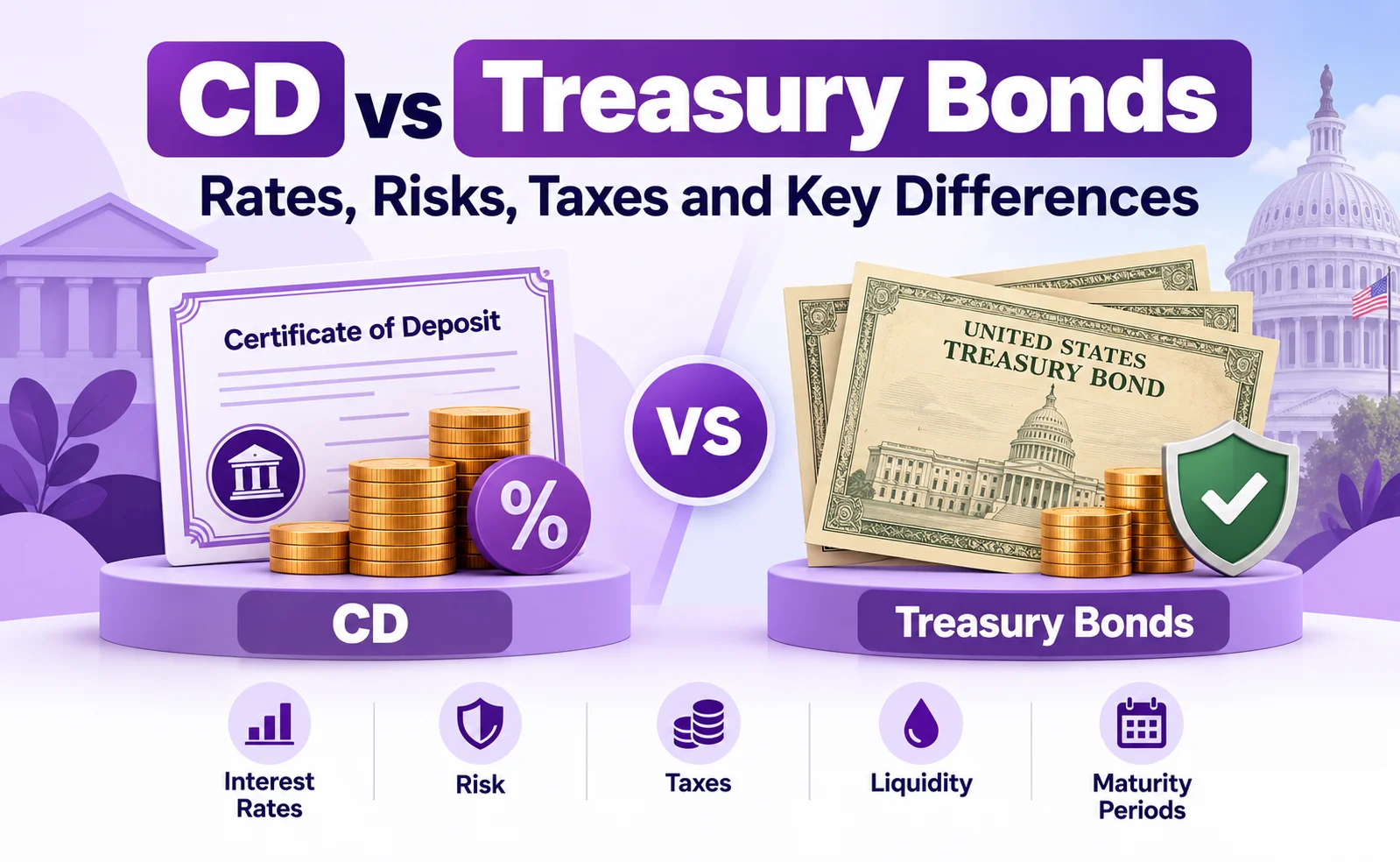
Table of Contents
CD vs Treasury Bonds: Key Differences, Taxes and Returns
When comparing a CD vs Treasury bond, the main differences are how the investment works, how it is protected, how interest is earned, and how taxes affect the final return. A certificate of deposit is a bank deposit that may qualify for FDIC insurance, while a US Treasury bond is a government security backed by the full faith and credit of the United States. Treasury bonds can be sold before maturity, but their market prices can change. A CD may offer a fixed rate for an agreed term, but early access can involve a penalty. The better option depends on your investment period, tax situation, liquidity needs, and the specific rates available.
Key takeaway: Eligible bank CDs and US Treasury securities have different forms of protection. CDs can qualify for FDIC deposit insurance within applicable limits. Treasury securities are backed by the US government but are not FDIC insured. A fair comparison should consider the return after taxes, the investment term, and whether you may need to access your money before maturity.
What Is a Certificate of Deposit?
A certificate of deposit, commonly called a CD, is a deposit account offered by a bank or other eligible financial institution. You deposit money for an agreed term, and the institution pays interest according to the account terms.
Traditional fixed rate CDs generally keep their contracted interest rate until maturity. Depending on the product, interest may be paid periodically, credited to the account, or paid at maturity. Taking money out before maturity may trigger an early withdrawal penalty.
The term can vary according to the institution’s offerings. Shorter terms may suit money needed in the near future, while longer terms may provide a fixed rate for a more extended period. The rate, minimum deposit, interest payment conditions, and withdrawal rules should be checked before opening the account.
Eligible CDs held at FDIC insured banks can qualify for deposit insurance, subject to the applicable coverage rules. For details on how this works, consult the FDIC’s guide to deposit insurance.
What Is a US Treasury Bond?
A US Treasury bond is a debt security issued by the US Department of the Treasury to finance government borrowing. When you buy one, you lend money to the federal government under the security’s terms. Treasury bonds pay interest every six months and repay their face value at maturity, provided the government meets its obligations.
Treasury bonds are different from Treasury notes and Treasury bills. Treasury bonds generally have original maturities of 20 or 30 years. Treasury notes cover intermediate maturities, while Treasury bills are short term securities that mature within one year and are generally issued at a discount rather than paying regular coupon interest.
This distinction matters when comparing products. A long term Treasury bond is not necessarily an appropriate substitute for a short term CD. The maturity date, interest payment structure, and risk from changes in market rates can be very different.
Treasury securities are backed by the full faith and credit of the US government. However, their market prices can fluctuate before maturity. If you need to sell a Treasury bond early, the price you receive may be above or below what you paid.
CD vs Treasury Bonds: Side by Side Comparison
The following table summarizes the main differences. Actual terms and outcomes depend on the CD or Treasury security selected and whether you hold it to maturity.
| Feature | Bank CD | US Treasury Bond |
|---|---|---|
| Issuer | A bank or other eligible deposit institution. | The US Department of the Treasury. |
| Protection | Eligible deposits at FDIC insured banks may receive deposit insurance within applicable limits. | Backed by the full faith and credit of the US government, but not insured by the FDIC. |
| Interest structure | Depends on the CD agreement. A traditional fixed rate CD generally retains its agreed rate until maturity. | Treasury bonds pay interest every six months under their terms. |
| Return measure | Annual percentage yield, or APY, helps show the annual effect of interest and compounding. | Yield to maturity reflects the purchase price and the expected return from contractual payments and principal repayment, subject to its assumptions. |
| Access before maturity | Traditional CDs may impose early withdrawal penalties. | Can generally be sold through the secondary market, but the sale price may be higher or lower than the purchase price. |
| Market price changes | A traditional bank CD is not normally traded at a changing market price. | Prices can fluctuate as market interest rates and other conditions change. |
| State and local taxes | Interest is generally taxable under applicable federal, state, and local rules. | Treasury interest is generally exempt from state and local income taxes. |
| Common purpose | Savings with a defined term and an agreed interest rate. | Government debt investment with specified payments and maturity terms. |
The comparison describes typical bank CDs and direct Treasury bonds. Brokered CDs, variable rate deposit products, and other Treasury securities may have different features.
Which Is Safer, a CD or a Treasury Bond?
Neither product should be evaluated by its name alone. A CD and a Treasury bond have different protections, and market risk matters when deciding whether to hold an investment to maturity or sell it earlier.
CD Protection and FDIC Insurance
The FDIC insures eligible deposits at participating banks against the failure of an insured institution. The standard coverage limit is $250,000 per depositor, per insured bank, for each account ownership category. The limit applies to combined eligible deposits within the same ownership category at the same bank, not separately to each CD.
For example, holding several CDs at the same bank does not automatically increase the coverage limit for an individual ownership category. You should review your total eligible deposits, account ownership, and any other balances held at that institution.
FDIC insurance protects covered deposits according to its rules. It does not eliminate early withdrawal penalties or guarantee that a particular CD has the best rate available.
Treasury Bond Protection and Market Risk
Treasury securities are backed by the US government. They are not bank deposits, so they do not receive FDIC insurance. Their market prices can fluctuate in the secondary market before maturity.
When market interest rates rise, existing fixed rate Treasury bonds can become less attractive compared with newly issued securities, so their market prices may fall. If market rates fall, existing bonds with higher coupon rates may become more valuable. The amount of price movement depends in part on the bond’s remaining maturity and other market factors.
If a Treasury bond is held until maturity and the government makes the required payments, the investor receives the contractual interest and face value. Selling earlier creates a different outcome because the proceeds depend on the market price at the time of sale.
For an official explanation, see Investor.gov’s guide to selling bonds before maturity.
CD vs Treasury Bond Tax Differences
Taxes can change which investment provides the higher amount of income after tax. The result depends on the interest rate or yield, the investment period, your tax circumstances, and applicable federal and state rules.
How CD Interest Is Taxed
Interest earned on a bank CD is generally subject to federal income tax and may also be subject to state and local income taxes. The precise reporting and timing can depend on the product and applicable tax rules.
How Treasury Bond Interest Is Taxed
Interest on US Treasury bonds is generally subject to federal income tax but exempt from state and local income taxes. This can make Treasury securities more attractive to some investors in states with income taxes, although the effect depends on the available yields and the individual’s tax situation.
The state tax exemption does not mean that Treasury interest is free from all taxes. Federal income tax generally still applies.
Compare After Tax Returns, Not Just Advertised Rates
A CD offering a higher APY may not necessarily produce the greater after tax return. Conversely, a Treasury bond’s state tax exemption does not guarantee that it will leave you with more income. The available rates or yields and the investor’s tax circumstances must be considered together.
For authoritative details about Treasury interest and other investment income, consult the IRS Publication 550 on investment income and expenses.
Interest Rate, APY, and Yield Differences
One of the most common mistakes when comparing a CD and a Treasury bond is treating their quoted interest figures as identical measurements.
Understanding CD APY
The annual percentage yield, or APY, expresses an annualized return that accounts for the effect of compounding under the product’s terms. The actual amount earned depends on the principal, the stated term, the interest arrangements, and whether the money stays invested as planned.
Understanding Treasury Bond Yield
A Treasury bond’s coupon rate determines the scheduled interest payments as a percentage of its face value. Yield to maturity is different. It takes the purchase price, coupon payments, remaining time to maturity, and face value repayment into account under specified assumptions.
Buying a Treasury bond at a premium or discount can make its yield to maturity differ from its coupon rate. An early sale can also produce a different return from the yield originally quoted because the selling price may change.
For a meaningful comparison, use the same investment amount and a comparable holding period. Consider fees, taxes, payment timing, the purchase price, and what happens when the investment matures.
What Happens When Interest Rates Change?
The effect of interest rate changes depends on the product’s terms and whether you need to sell before maturity.
When Interest Rates Rise
An existing fixed rate CD generally keeps its agreed rate until maturity. New CDs may offer different rates, so the investor may have to wait until maturity to move the money into a new product without an early withdrawal penalty.
An existing Treasury bond may decline in market value when comparable market yields rise. An investor who holds the bond until maturity and receives all required payments is in a different position from someone who must sell during a period of lower market prices.
When Interest Rates Fall
A fixed rate CD can continue earning its agreed rate until maturity, even when newly offered CD rates decline. However, reinvesting the proceeds may mean accepting a lower rate.
An existing Treasury bond with a higher coupon rate may rise in market value when comparable market yields fall. Its actual value depends on the remaining maturity, the coupon, and other market conditions.
Neither investment completely removes interest rate or reinvestment risk. The main difference is how the contracted deposit terms and market price of the Treasury security affect the investor’s options.
Liquidity and Access Before Maturity
If you might need your money before the planned maturity date, access conditions deserve particular attention.
Accessing Money in a CD
A traditional bank CD may allow an early withdrawal but impose a penalty. The penalty can reduce the interest earned, and the exact terms depend on the contract. Some products have different withdrawal rules, so the agreement should be reviewed before investing.
Brokered CDs are different from many traditional bank CDs. They may be sold in a secondary market, but the selling price can be above or below the original purchase price. They should not automatically be treated as having the same early access terms as a direct bank CD.
Accessing Money in a Treasury Bond
Treasury bonds can generally be sold through the secondary market before maturity. However, the proceeds depend on the price available at the time of sale, and transaction costs or broker charges may apply.
This can provide a route to access funds before maturity, but it does not guarantee that the investor will recover the original purchase price. Longer term bonds can be particularly sensitive to changing market yields.
Money needed for immediate expenses is usually best kept accessible rather than being committed to an investment that may have early withdrawal costs or an uncertain sale price.
Illustrative Example: Comparing a CD With a Treasury Bond
A Hypothetical $10,000 Investment
Suppose an investor has $10,000 and is considering two options. The first is a traditional fixed rate CD with a hypothetical APY of 4.00%. The second is a hypothetical Treasury bond with a yield to maturity of 4.10% at the purchase price.
These figures are illustrations only, not current market offers. They also do not mean the two products have identical terms or risk characteristics.
The investor would need to check the CD’s term and early withdrawal penalty, the Treasury bond’s purchase price and maturity, its coupon payments, any transaction costs, and the relevant taxes before comparing the expected outcome.
The hypothetical Treasury yield is slightly higher before tax, but the figures alone are not enough to determine the better investment. The Treasury’s state and local tax exemption might matter, while the CD’s quoted APY reflects compounding according to its terms. The Treasury’s yield to maturity also assumes that the investment is held through maturity and that required payments are made.
If the investor expects to sell the Treasury bond early, its actual return could be different from the original yield to maturity. If the investor withdraws the CD early, the penalty could change the amount earned.
For the CD side of the analysis, the SooperTools CD calculator can estimate interest and maturity value from the inputs you enter. It does not calculate Treasury bond market prices or provide personalized tax calculations.
When Might a CD Be the Better Fit?
A CD may suit someone who wants a defined deposit term and a fixed rate for that period. Eligible CDs at FDIC insured banks may also provide deposit insurance within the applicable limits.
A CD may be worth considering when:
- You can leave the money invested until the agreed maturity date.
- You value a fixed rate for a defined period.
- You want to avoid fluctuations in the market price of an individual Treasury bond.
- The available CD terms fit your planned expenses.
- The rate remains competitive after considering taxes and withdrawal restrictions.
A CD may be less suitable when you expect to need the money early or want the ability to sell the investment through a securities market. The actual deposit insurance coverage and withdrawal terms should always be checked.
When Might a Treasury Bond Be the Better Fit?
A Treasury bond may suit an investor who wants direct exposure to US government debt, can accept the security’s maturity and market price behavior, and understands how its tax treatment affects the overall return.
A Treasury bond may be worth considering when:
- You want an investment backed by the full faith and credit of the US government.
- You can hold the security until maturity or understand the risks of selling it early.
- The coupon schedule and maturity fit your financial goals.
- The state and local tax exemption has value in your situation.
- The yield and other terms compare favorably with available CD offers.
A Treasury bond may be less suitable when a long maturity does not fit your timeframe or when you may need to sell during unfavorable market conditions. If you need a shorter maturity, compare the terms of Treasury notes or bills as appropriate rather than assuming a long term bond is the closest alternative to a CD.
How to Compare CDs and Treasury Bonds Before Investing
Before making a decision, compare the actual products rather than relying on a headline interest rate.
- Match the time horizon. Compare products with maturity dates that fit the period for which you can leave the money invested.
- Compare the return measure. Review CD APY alongside Treasury yield to maturity, recognizing that these figures are calculated differently.
- Calculate the after tax outcome. Account for federal, state, and local tax treatment where applicable.
- Check access conditions. Review CD penalties and consider the possibility of a Treasury bond selling at a loss.
- Verify protection. Confirm the bank’s FDIC status and how your deposits fit within the insurance limits, or review the Treasury security’s terms.
- Consider reinvestment. Think about what you will do when a CD matures or when Treasury principal is repaid.
If you are comparing several CD offers, the SooperTools CD comparison calculator can help evaluate their estimated interest and maturity values. The calculation should not be treated as a complete comparison with Treasury securities, which have different pricing and yield characteristics.
Frequently Asked Questions
Are Treasury Bonds Safer Than CDs?
They have different forms of protection. Eligible bank CDs can receive FDIC deposit insurance within applicable limits, while Treasury securities are backed by the full faith and credit of the US government. Treasury bonds can still lose market value if sold before maturity. The appropriate choice depends on the product, holding period, and the risks that matter to the investor.
Are Treasury Bond Interest Payments Exempt From State Taxes?
Interest from US Treasury securities is generally exempt from state and local income taxes but remains subject to federal income tax. CD interest is generally subject to applicable federal and state income tax rules. Check the rules that apply to your circumstances before comparing after tax returns.
Which Earns More, a CD or a Treasury Bond?
Neither consistently earns more. The outcome depends on the CD APY, Treasury yield to maturity, purchase price, holding period, fees, reinvestment assumptions, and taxes. Compare products with similar maturity periods and calculate the expected outcome using clearly stated assumptions.
Can I Sell a Treasury Bond Before Maturity?
Yes, Treasury bonds can generally be sold through the secondary market before maturity. The price depends on market conditions, including changes in interest rates. You may receive more or less than your original purchase price, and transaction costs may apply.
What Is the Difference Between a Treasury Bond, Note, and Bill?
Treasury bonds generally have original maturities of 20 or 30 years. Treasury notes have intermediate maturities, and Treasury bills mature within one year. Bonds and notes generally pay scheduled coupon interest, while bills are usually sold at a discount and pay face value at maturity.
Are Treasury Bonds FDIC Insured?
No. Treasury bonds are not bank deposits and are not insured by the FDIC. They are backed by the full faith and credit of the US government. Eligible CDs at FDIC insured banks may qualify for deposit insurance under the applicable limits and ownership rules.
Related Tools
Use these SooperTools resources to explore the CD side of your comparison.
CD Calculator
Estimate CD interest and maturity value using your deposit amount, APY, and term.
CD Maturity Calculator
Estimate an individual CD’s maturity date and projected value based on the information you enter.
CD Comparison Calculator
Compare multiple CD offers using their deposit amounts, rates, terms, and estimated returns.
Final Considerations
A CD and a Treasury bond may both have a place in a savings or fixed income plan, but they are not interchangeable. A CD may offer a fixed deposit rate and potential FDIC insurance, while a Treasury bond provides exposure to US government debt with market prices that can change before maturity.
Compare the actual yield, taxes, maturity date, liquidity, and protection rather than choosing from a quoted rate alone. Your time horizon and likelihood of needing the money early are just as important as the expected return.
This article provides general financial education, not individualized financial or tax advice. Consider your circumstances and consult a qualified professional when you need guidance tailored to your situation.
Authoritative References
- Federal Deposit Insurance Corporation: Understanding Deposit Insurance. Explains eligible deposit products, standard coverage limits, and ownership categories.
- TreasuryDirect: Treasury Bonds. Provides official information about Treasury bond terms, interest payments, and maturity.
- Investor.gov: Bonds and Selling Before Maturity. Explains why a bond sold before maturity can produce more or less than its face value.
- Internal Revenue Service: Publication 550, Investment Income and Expenses. Provides federal tax guidance on investment income.