
IRA CD Ladder
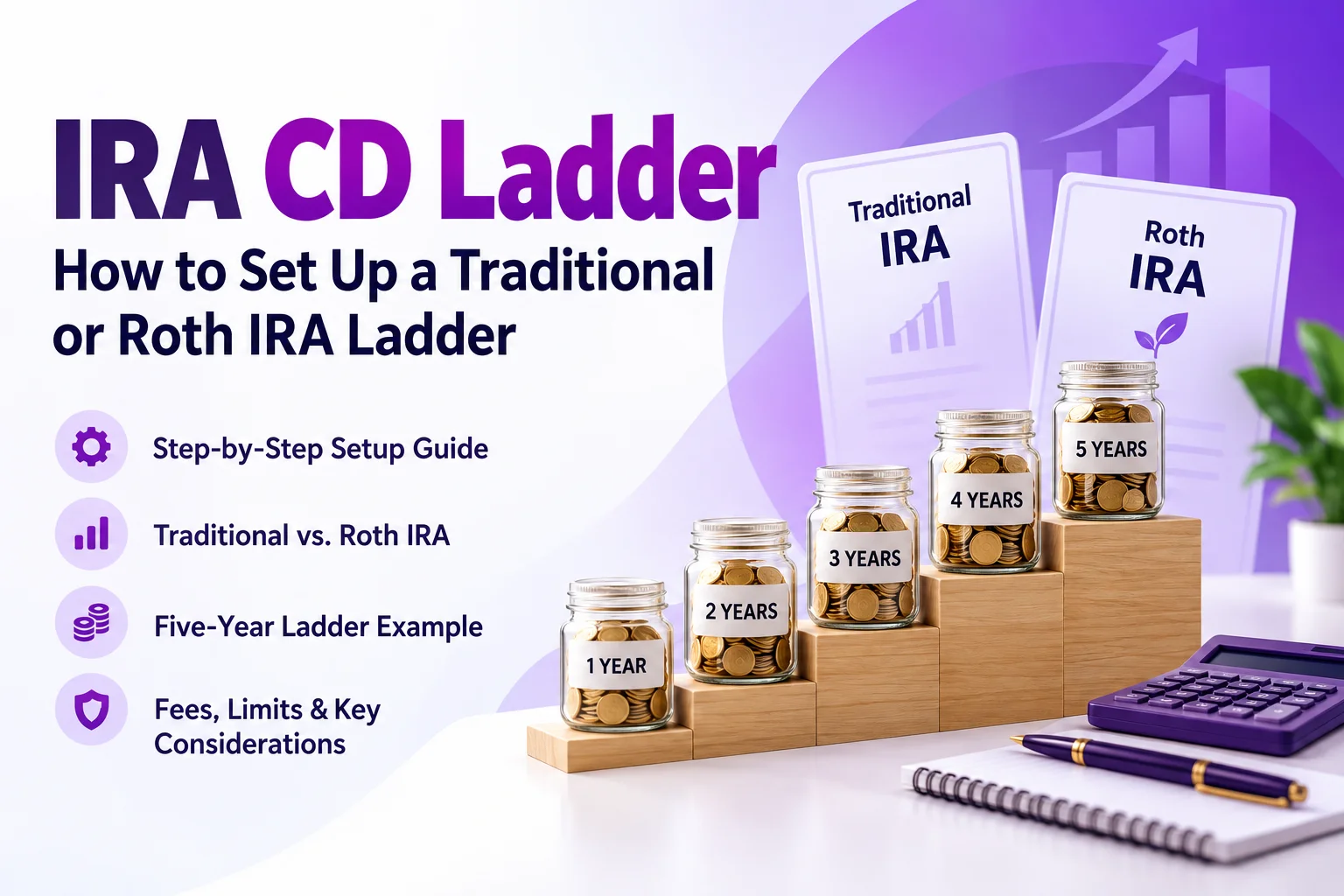
Table of Contents
IRA CD Ladder: How to Set Up a Traditional or Roth IRA Ladder
An IRA CD ladder combines certificates of deposit (CDs) with the tax-advantaged structure of an Individual Retirement Account (IRA). It spreads money across CDs with different maturity dates so that portions of the account mature at different times. This approach can help retirement savers plan when to reinvest funds while earning the contracted interest on CDs held to maturity.
To build an IRA CD ladder, first determine which type of IRA you have, confirm that your bank or brokerage offers suitable CDs within that account, choose the maturities and amounts, and establish a plan for handling each maturity. Traditional and Roth IRAs have different tax rules, so the right setup depends on your account, retirement objectives, available products, and withdrawal plans.
Key distinction: The IRA is the retirement account that determines the applicable tax framework. The CDs are the deposits or investments held within that account. A CD maturing inside an IRA is not automatically the same as taking money out of the IRA, and CD withdrawal penalties are different from potential IRA distribution taxes or penalties.
What Is an IRA CD Ladder?
An IRA CD ladder is a series of certificates of deposit held within an eligible IRA arrangement, with different maturity dates selected to spread the timing of interest-rate commitments and reinvestment decisions.
An IRA is not itself a CD. It is a retirement account with rules governing contributions, investments, and distributions. Depending on the provider, an IRA may hold bank-issued IRA CDs or brokered CDs purchased through an IRA brokerage account. These products can have different terms, access procedures, fees, and risks.
For example, a five-year ladder might initially use CDs with one-year, two-year, three-year, four-year, and five-year terms. As each CD matures, the account holder can evaluate whether to reinvest its proceeds, retain them as cash within the IRA, or take an eligible distribution if the retirement-account rules and personal circumstances allow.
The ladder does not guarantee a particular return across all five years. The initial CDs have their own contracted rates and terms, while future returns depend partly on the rates available when matured funds are reinvested.
For a general explanation of staggered CD maturities, see the CD ladder guide. This article focuses on what changes when the ladder is held inside an IRA.
How to Set Up a CD Ladder in an IRA
The setup process involves both the retirement account and the CDs selected for it. Do not assume that every bank or brokerage supports every maturity, ladder arrangement, or type of CD within every IRA account.
1. Confirm Your IRA Type and Provider
Identify whether you have a traditional IRA or Roth IRA and confirm that the account can hold the CDs you are considering. Ask your current custodian or prospective provider how IRA CDs are opened, purchased, managed, and renewed.
If you plan to move assets from an existing retirement account, confirm the appropriate transfer or rollover process with the receiving institution. Moving retirement funds incorrectly can create tax consequences. Do not treat an IRA transfer as an ordinary deposit into a personal bank account.
2. Determine the Amount Available for the Ladder
Decide how much of the IRA you want to allocate to CDs after considering your investment objectives, expected retirement timeline, diversification needs, fees, and other holdings. An IRA CD ladder may be appropriate for some retirement goals, but it is not automatically suitable for an entire retirement portfolio.
Check the minimum deposit or purchase amount for every CD and confirm whether your account charges maintenance fees, transaction fees, or other costs that could affect the strategy.
3. Choose the CD Terms
Select a maturity schedule that fits your intended time horizon. A ladder with one-year through five-year CDs spreads the initial maturities across five years. A shorter schedule could make funds available sooner, while a longer schedule may commit money for more time.
Compare each CD’s annual percentage yield (APY), term, issuer, minimum investment, maturity instructions, and any early-termination or secondary-market conditions. Do not select a term based on APY alone.
4. Allocate the Money Across the Rungs
Divide the planned investment among the selected CDs. Equal allocations are easy to manage, but they are not required. Your allocation may depend on available minimums, the amount you want maturing sooner, and how much you wish to commit for longer periods.
5. Plan What Happens at Maturity
Ask the provider whether maturing proceeds remain in the IRA’s cash balance, whether automatic renewal is available, and how much time you have to make a choice. If you want to keep a rolling ladder, you may be able to reinvest a matured CD into a new longer-term CD, subject to available products and account rules.
Review the arrangement when each CD matures rather than automatically renewing it. The appropriate choice can change with interest rates, retirement timing, required distributions, cash needs, and the account’s investment objectives.
Example: How to Set Up a Five-Year CD Ladder in an IRA
A five-year IRA CD ladder can be illustrated by splitting a hypothetical $20,000 allocation across five CDs with different terms. The amounts and terms below are for demonstrating the structure only. They are not current rate offers or a recommendation for a particular investor.
Illustrative Five-Rung Arrangement
| CD rung | Illustrative term | Initial allocation | Scheduled maturity |
|---|---|---|---|
| 1 | 1 year | $4,000 | After approximately 1 year |
| 2 | 2 years | $4,000 | After approximately 2 years |
| 3 | 3 years | $4,000 | After approximately 3 years |
| 4 | 4 years | $4,000 | After approximately 4 years |
| 5 | 5 years | $4,000 | After approximately 5 years |
| Total | Five CDs | $20,000 | Five initial maturity dates |
This arrangement creates an initial maturity schedule across five years. After the first CD matures, the account holder could choose a new term for the proceeds if they want to maintain a ladder with more frequent future maturities.
The example assumes that the provider offers the selected terms, accepts the proposed allocations, and supports the intended IRA transactions. Actual availability and account procedures must be confirmed before implementing the ladder.
How the Ladder Can Continue After the First Maturity
If the one-year CD matures and the money remains earmarked for retirement savings, you might reinvest the proceeds in a new five-year CD. If a suitable five-year CD is available and you choose that option, the new CD would mature approximately one year after the original five-year CD’s maturity date. Over time, this reinvestment pattern can create recurring annual maturity opportunities.
Future CDs may offer different rates from the original CDs. Before reinvesting, compare the new APY and terms, consider any upcoming retirement distributions, and confirm that the transaction is handled within the IRA.
Use the CD Ladder Calculator to model different amounts and maturity schedules. It can help estimate a ladder based on the assumptions you enter, but it does not determine the tax treatment of IRA transactions or predict future rates.
CD Ladder in a Roth IRA vs. a Traditional IRA
A CD ladder can be held within different types of IRAs when the provider supports the required investments. The ladder’s maturity strategy may be similar in both account types, but the tax treatment of contributions and distributions is different.
| Consideration | Traditional IRA | Roth IRA |
|---|---|---|
| Account purpose | Retirement savings with traditional IRA tax rules | Retirement savings with Roth IRA tax rules |
| CD ladder structure | Can use staggered CD maturities if the provider supports them | Can use staggered CD maturities if the provider supports them |
| Distribution tax treatment | Distributions are generally taxable as ordinary income, subject to applicable basis and exception rules | Qualified distributions can be tax-free; nonqualified distributions follow different ordering and tax rules |
| Required minimum distributions | Generally apply to the original account owner under the relevant rules | The original account owner generally does not have lifetime required minimum distributions |
| Important checks | Distribution timing, taxes, account fees, maturity and reinvestment rules | Qualified-distribution requirements, account rules, maturity and reinvestment rules |
These are high-level distinctions, not a complete tax analysis. The IRS provides detailed rules in Publication 590-B: Distributions from Individual Retirement Arrangements. Tax treatment depends on individual circumstances, including contributions, account history, age, the type of transaction, and applicable exceptions.
Can You Build a CD Ladder in a Roth IRA?
Yes, a Roth IRA can hold CDs when the account provider offers eligible CD products for that account. The account holder can choose different terms and establish a maturity schedule, subject to product availability and the provider’s procedures.
The fact that an account is a Roth IRA does not make every CD maturity or withdrawal tax-free. Simply reaching the maturity date of a CD inside the IRA is different from taking money out of the IRA. Before withdrawing funds, confirm the distribution rules that apply to your situation.
A Roth IRA ladder should be considered in the context of the entire retirement account. The decision to hold CDs, how long to commit money, and whether to reinvest matured proceeds should reflect your intended use of the account and other retirement holdings.
Bank IRA CDs vs. Brokered CDs in an IRA
The type of provider you choose can affect the products available, how you purchase CDs, how maturities are handled, and what happens if you want to sell an investment before maturity.
Bank IRA CDs
A bank may offer CDs that are specifically opened within an IRA. The bank’s terms determine the available maturities, minimum deposits, interest calculation, early-withdrawal rules, automatic-renewal options, and account fees.
Ask whether the provider offers all the terms required for your ladder. If one institution does not offer the maturity dates you need, you may need to consider another provider or a different structure.
Brokered CDs
A brokerage IRA may offer brokered CDs issued by banks. These are different from opening a CD directly at the issuing bank. For example, Fidelity’s CD information explains how brokered CDs work and describes its CD laddering and Auto Roll options.
Brokered CDs can have different liquidity and pricing characteristics from traditional bank CDs. Some may be sold in a secondary market before maturity, but the sale price can be higher or lower than the original purchase price. Do not assume you can sell a brokered CD at face value or without a potential loss.
If you are researching a Fidelity IRA CD ladder, compare the available maturities, minimum denominations, issuer information, fees, trading conditions, maturity instructions, and automatic reinvestment settings for the particular account. The availability of a product and its conditions can change, so confirm current terms directly with the provider.
Fees, Deposit Insurance, and Other Limitations
Before placing IRA assets in CDs, review how the product is held, what protection applies, and which costs may affect your results.
Deposit Insurance
Eligible deposits at an FDIC-insured bank are generally insured up to $250,000 per depositor, per insured bank, per ownership category. Certain retirement accounts, including qualifying IRA deposits, are included in a separate retirement-account ownership category under FDIC rules.
Coverage is subject to the applicable rules and the identity of the issuing bank. Holding multiple CDs in the same ownership category at one bank does not automatically provide a separate $250,000 limit for each CD. For brokered CDs, check the issuing bank and your other deposits at that institution. The FDIC explains these requirements in its guide to understanding deposit insurance.
Fees and Minimums
Account maintenance fees, transaction charges, CD minimums, and other costs can reduce the value of a ladder, particularly when it uses several small positions. Ask for the complete fee schedule and confirm that the proposed allocation meets the provider’s minimum requirements.
Liquidity and Early-Withdrawal Conditions
A bank CD may impose a contractual early-withdrawal penalty. A brokered CD may have different sale and pricing conditions if you need to exit before maturity. In either case, the CD’s terms matter.
An early-termination penalty on a CD and an early distribution from the IRA are two separate matters. If funds are withdrawn from the IRA itself, tax and additional-tax rules may apply depending on the transaction and the account holder’s circumstances.
For the CD penalty mechanics, see the CD Early Withdrawal Penalty guide. For estimating a possible contractual penalty, use the CD Early Withdrawal Penalty Calculator. Neither resource determines whether an IRA distribution is taxable.
Questions to Ask Before Opening an IRA CD Ladder
Use this checklist when comparing a bank IRA CD with a brokerage IRA that offers CDs.
- Can this IRA account hold multiple CDs with different maturity dates?
- Which CD terms, minimum deposits, and APYs are available for my account?
- Are the CDs bank-issued IRA deposit products or brokered CDs?
- What fees apply to the IRA and to purchasing or selling CDs?
- What happens to principal and interest when each CD matures?
- Will a CD renew automatically, and what is the process for changing the instruction?
- What penalty or market-price risk applies if I need to exit before maturity?
- Which bank issues each CD, and how does FDIC coverage apply to my eligible deposits?
- How are transfers or rollovers from an existing retirement account handled?
- How will the ladder work alongside any required distributions, planned withdrawals, and other retirement investments?
Getting these answers before opening the ladder can help prevent account, liquidity, and administrative surprises later.
Related Tools
These tools can help you plan the CD component of an IRA strategy. They estimate CD-related outcomes based on your inputs; they do not calculate personalized IRA tax liability or determine whether a retirement transaction is permitted.
- CD Ladder Calculator — Model CD terms, allocations, maturity schedules, and projected returns using your selected assumptions.
- CD Calculator — Estimate interest and maturity value for an individual certificate of deposit.
For broader retirement cash-flow planning, read the guide to CD ladders for retirement income. To compare current APYs across CD terms, consult the CD Ladder Rates guide.
Frequently Asked Questions About IRA CD Ladders
1. What Is an IRA CD Ladder?
An IRA CD ladder is a group of certificates of deposit held within an IRA, with different terms and maturity dates. It can spread reinvestment dates over time, but future returns depend on the rates available when matured funds are reinvested.
2. How Do I Set Up a CD Ladder in an IRA?
Confirm the IRA type and provider, determine the amount to allocate, select available CD terms, divide the money among the rungs, and establish maturity instructions. Check fees, minimum deposits, insurance coverage, and distribution considerations before opening the CDs.
3. Can You Build a CD Ladder in a Roth IRA?
Yes, if the bank or brokerage supports the required CD products within its Roth IRA accounts. The ladder strategy can use staggered maturities, while the Roth IRA’s distribution rules remain applicable to money taken out of the retirement account.
4. How Do You Set Up a Five-Year CD Ladder in an IRA?
One possible arrangement uses one-year, two-year, three-year, four-year, and five-year CDs. Divide the planned allocation across the five terms, subject to account minimums and product availability. When each CD matures, decide whether to reinvest the proceeds or retain them within the IRA.
5. Are Traditional IRA CDs and Roth IRA CDs Taxed Differently?
Yes. Traditional IRA distributions are generally taxable as ordinary income, subject to applicable rules and basis. Qualified Roth IRA distributions can be tax-free, while nonqualified distributions follow different tax rules. Review IRS guidance or consult a qualified tax professional for your circumstances.
6. What Happens When an IRA CD Matures?
The proceeds are handled under the account and CD terms. They may remain as cash within the IRA or be reinvested according to your instructions or an automatic-renewal arrangement. Confirm the provider’s maturity process and review the available rates before reinvesting.
7. Is a CD Early-Withdrawal Penalty the Same as an IRA Tax Penalty?
No. A CD may have a contractual penalty for ending the deposit early. An IRA distribution can separately have income-tax consequences or an additional tax depending on the circumstances. Ending a CD inside an IRA without taking money out of the IRA is different from making an IRA distribution.
8. Should I Use a Bank IRA CD or Brokered CDs in an IRA?
Compare the available terms, rates, fees, minimums, account procedures, issuing banks, and early-exit conditions. Bank IRA CDs and brokered CDs have different features, so the appropriate option depends on your account and how you expect to manage maturities.
9. Are IRA CDs Covered by FDIC Insurance?
Eligible bank deposits held in qualifying IRA ownership categories can be covered by FDIC insurance, generally up to $250,000 per depositor, per insured bank, per ownership category. Coverage depends on the issuing institution, account ownership, and applicable rules. Verify coverage for your specific CDs and other deposits.
10. Is an IRA CD Ladder Suitable for Every Retirement Investor?
No. The strategy may suit someone seeking a structured schedule of CD maturities, but it does not automatically meet every investor’s needs. Consider diversification, inflation, fees, access requirements, retirement timing, and whether locking money into CDs fits your broader plan.
Final Considerations
An IRA CD ladder combines staggered CD maturities with the rules of a retirement account. Before setting one up, confirm that the provider supports your intended structure, compare the available terms and fees, and establish clear instructions for handling matured proceeds.
Pay particular attention to the difference between a CD’s contractual terms and the IRA’s contribution and distribution rules. The ladder can help organize maturity dates, but it does not guarantee future rates, remove investment trade-offs, or determine the tax consequences of a withdrawal.
References
- Internal Revenue Service: Publication 590-B, Distributions from Individual Retirement Arrangements
- Internal Revenue Service: Topic No. 557, Additional Tax on Early Distributions from Traditional and Roth IRAs
- Federal Deposit Insurance Corporation: Understanding Deposit Insurance
- Fidelity: Certificates of Deposit and Brokered CDs
This article is for general educational purposes only and is not individualized investment or tax advice. CD availability, rates, fees, account procedures, deposit-insurance coverage, and tax treatment depend on the product and individual circumstances. Confirm details with the account provider and consult a qualified tax professional when necessary.