
CD Ladder for Retirement Income
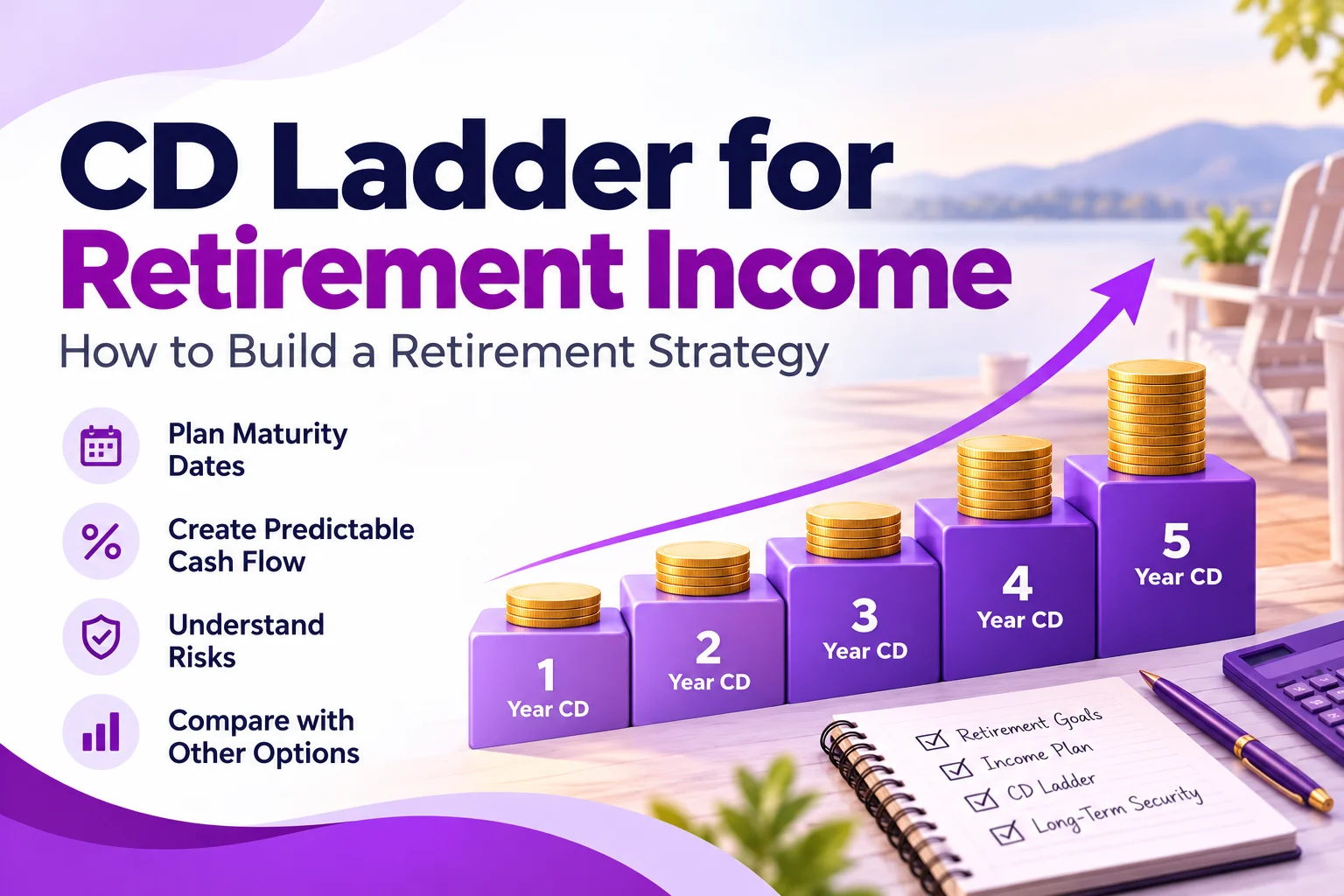
Table of Contents
CD Ladder for Retirement Income: How to Build a Retirement Strategy
A CD ladder for retirement income is a savings strategy that spreads money across certificates of deposit (CDs) with different maturity dates. Instead of locking all your money into one CD, you arrange for portions to mature at different times. This can help coordinate access to savings with planned retirement expenses while providing known interest terms for CDs held to maturity.
A CD ladder does not guarantee lifetime income. It can provide a schedule of maturing principal and interest, but your long-term results depend on how much principal you spend, future reinvestment rates, inflation, taxes, and other retirement resources. The goal is to build a maturity schedule around your spending needs rather than simply choosing the CDs with the highest advertised annual percentage yield (APY).
Key point: A CD ladder can help organize retirement cash flow, but maturing principal is not the same as recurring investment income. Spending the principal reduces the amount left to generate future returns, while reinvesting it keeps more money invested but leaves future rates uncertain.
How Does a CD Ladder Work for Retirement?
A CD ladder divides a planned investment into several CDs with different terms. As each CD matures, you can withdraw the proceeds to help meet retirement expenses or reinvest the money in another CD. The appropriate choice depends on your spending plan and whether you need the principal.
For someone approaching retirement, the first maturity dates can be arranged around the transition from employment to retirement. For someone already retired, the ladder can be coordinated with expected withdrawals, pension payments, Social Security, and other available resources.
CD interest may be paid periodically or at maturity, depending on the product. Principal is generally returned according to the CD’s terms when it matures. Check the account agreement to understand the payment schedule, maturity instructions, and whether automatic renewal is enabled.
For the general mechanics of staggered maturities, see the CD ladder guide. This article focuses on coordinating that strategy with retirement spending.
How to Build a CD Ladder for Retirement
A retirement ladder works best when it starts with a cash-flow plan. Determine when you will need money, which expenses other income sources already cover, and how much you can commit to CDs without undermining your access to cash.
1. Estimate Your Retirement Spending Needs
Start by estimating essential expenses such as housing, utilities, food, insurance, transportation, healthcare, and debt payments. Separate these costs from discretionary spending and occasional larger expenses.
Next, identify the income you expect from sources such as Social Security, pensions, employment, or other investments. The difference between your planned spending and reliable income helps you estimate how much additional cash flow your savings may need to support.
Do not assume every gap must be filled by CD interest. A retirement plan may involve interest, dividends, other withdrawals, and spending principal. Each has different implications for liquidity and the amount remaining for later years.
2. Establish a Cash Reserve Outside the Ladder
Keep accessible savings for unexpected expenses and bills that arise between CD maturities. The size of this reserve depends on your expenses, income reliability, health and home costs, and access to other resources.
A maturity schedule should not be your only source of short-notice money. Withdrawing from a traditional CD before maturity may trigger a contractual penalty, while selling a brokered CD before maturity may result in a price below your purchase amount.
3. Choose the Ladder Horizon
Select CD terms based on when the money may be needed. A ladder with one-year through five-year CDs spreads its initial maturity dates across five years. A shorter schedule may better fit near-term withdrawals, while longer terms may lock in rates for more time.
There is no single maturity pattern suitable for every retiree. Your ladder should reflect the timing of your spending needs, the amount of money allocated to CDs, and the terms actually available from your financial institution.
4. Divide the Allocation Across Maturities
Equal allocations can make a ladder easier to manage. Unequal amounts may be useful when you expect larger expenses at particular times or have different amounts available for each term.
For each CD, record the amount invested, APY, maturity date, interest-payment schedule, issuer, minimum deposit, and withdrawal conditions. Confirm whether each product is a bank CD or a brokered CD because the terms and risks can differ.
5. Decide What to Do at Each Maturity
When a CD matures, choose whether to use the proceeds for spending, leave the money temporarily in cash, or reinvest it. Reinvesting matured funds in a new longer-term CD can maintain a rolling ladder, but the new rate may be higher or lower than the rate on the original CD.
Review your spending plan before automatically renewing a CD. Retirement needs can change, and money that was previously available for reinvestment may be needed for living expenses or an unexpected cost.
Example: A Five-Year CD Ladder for Retirement
The following example demonstrates how a retirement ladder can spread maturity dates. The amount and allocation are hypothetical. They are not a recommended investment percentage, a prediction of returns, or a substitute for a complete retirement plan.
Illustrative Five-Rung Ladder
Suppose a retiree allocates $250,000 to a CD ladder and divides it equally across five CDs. Each CD receives an initial allocation of $50,000, with terms ranging from one to five years.
| CD rung | Term | Initial allocation | Approximate initial maturity |
|---|---|---|---|
| 1 | 1 year | $50,000 | Year 1 |
| 2 | 2 years | $50,000 | Year 2 |
| 3 | 3 years | $50,000 | Year 3 |
| 4 | 4 years | $50,000 | Year 4 |
| 5 | 5 years | $50,000 | Year 5 |
| Total | Five CDs | $250,000 | Five initial maturity dates |
When the first CD matures, the retiree can use the principal and any interest payable at maturity for planned expenses, or reinvest some or all of the proceeds. If the goal is to keep the ladder going, reinvesting the first maturity into a new five year CD could establish another future maturity point, subject to the available terms.
What the Example Does and Does Not Show
The example shows how a maturity schedule can be arranged. It does not establish how much retirement income the ladder will generate. That depends on the actual APYs, how and when interest is paid, taxes where applicable, reinvestment decisions, and whether principal is spent.
If a retiree spends the entire $50,000 principal when the first CD matures, that amount is no longer invested in the ladder. If the retiree reinvests it, the principal remains invested but is not available for that year’s spending without another source of cash.
For a retirement portfolio worth $3 million, the same principle applies. A ladder could be a component of a broader plan, but the amount allocated to CDs should be chosen in light of expected expenses, other investments, risk tolerance, and the role of the remaining assets. A $3 million portfolio does not automatically imply a particular CD allocation or retirement-income result.
Use the CD Ladder Calculator to model different deposit amounts, maturities, and rates. It can help estimate a scenario, but it does not predict future CD rates or determine how much you can safely spend throughout retirement.
Setting Up a CD Ladder Before Retirement
Building a ladder before retirement can help you align initial maturity dates with a planned retirement date. For example, if you expect to stop working in several years, you can review when each CD will mature and whether the proceeds will be available for the transition.
The important step is coordinating the ladder with the rest of your plan. Consider when employment income will stop, when other retirement income sources will begin, and how much cash you may need during the first years of retirement.
A ladder should not be built around maturity dates alone. You should also consider the emergency reserve, potential healthcare and housing costs, taxes, and the rest of your retirement portfolio. If you are using an IRA to hold the CDs, account-specific contribution and distribution rules also matter.
Read the IRA CD Ladder guide for more information about holding a CD ladder inside a traditional or Roth IRA.
Managing CD Maturities During Retirement
Once retirement begins, the ladder becomes part of an ongoing spending and reinvestment process. Each maturity is a decision point rather than an automatic income payment that must be reinvested.
Use Maturing Principal for Planned Expenses
If you expect a larger expense in a particular year, a CD maturing around that time may help provide funds. Match the maturity date to the expected expense with enough flexibility for processing and transfer times.
Remember that the principal returned at maturity is money you previously invested. It can support spending, but spending it reduces the amount left in the ladder to generate interest in later years.
Reinvest When the Money Is Not Needed
If other income and available cash cover your expenses, you may choose to reinvest matured funds. Compare current APYs, terms, minimum deposits, and account conditions. A new CD does not necessarily offer the same rate as the one that just matured.
Current interest-rate information can be reviewed in the CD Ladder Rates guide. Rates shown in any rate comparison should be checked against the issuing institution before you make a decision.
Coordinate With Other Income Sources
A CD ladder usually works best as one component of a broader retirement cash-flow plan. Some expenses may already be covered by Social Security, a pension, or other sources. A ladder can then be designed around the remaining funding needs rather than being expected to cover every expense.
If you hold CDs within a tax-advantaged retirement account, consider the account’s distribution rules separately from the CD’s maturity terms. The Internal Revenue Service provides information about required minimum distributions in its retirement plan and IRA distribution guidance. Rules vary by account type and individual circumstances.
Risks of Using a CD Ladder for Retirement Income
A CD ladder can make the timing of some cash flows easier to plan, but it does not remove the main risks involved in funding retirement over many years.
Reinvestment Risk
When a CD matures, the rate available on a replacement CD may be lower than the original rate. If rates fall, the ladder may generate less interest as individual CDs mature and are renewed. If rates rise, existing fixed-rate CDs may continue paying their contracted rates until maturity, which can mean missing newer, higher offers for that money.
Inflation Risk
CD interest and principal are stated in nominal dollars. If the cost of living rises, the same dollar amount may buy fewer goods and services in the future. The Bureau of Labor Statistics’ guide to income and the Consumer Price Index explains how inflation affects purchasing power.
A ladder concentrated in fixed-rate CDs may therefore have difficulty maintaining purchasing power over a long retirement, especially if spending rises faster than the ladder’s income. This is one reason to consider the ladder alongside other assets and retirement-income sources rather than treating it as a complete long-term plan.
Liquidity and Early-Withdrawal Risk
If you need money before a bank CD matures, an early-withdrawal penalty may apply under the contract. Brokered CDs may have to be sold before maturity, and their market prices can be above or below the amount invested. Keep accessible cash for expenses that cannot wait for a maturity date.
Deposit Insurance and Concentration
Eligible CDs at FDIC-insured banks are generally covered up to $250,000 per depositor, per insured bank, per ownership category. The FDIC aggregates eligible deposits within each category at the same bank, so opening multiple CDs does not automatically create a separate insurance limit for every CD. Coverage depends on the issuing institution, account ownership, and applicable rules.
The FDIC guide to understanding deposit insurance explains coverage categories. Verify the issuing bank and your other eligible deposits before placing a large retirement allocation into CDs. Brokered products also need to be assessed based on the issuing institution and product terms.
Longevity Risk
A CD ladder does not guarantee that your savings will last for the rest of your life. The outcome depends on how much you spend, the return on reinvested funds, inflation, and other sources of income. A plan that spends too much principal early may leave less available for later years.
Annuity vs. CD Ladder: What Is the Difference?
A CD ladder and an annuity can both play a role in retirement planning, but they address different needs. A CD ladder organizes deposits into staggered maturities. An annuity is an insurance contract that may provide periodic income payments for a specified period or for life, depending on its terms.
| Consideration | CD ladder | Annuity |
|---|---|---|
| Payment structure | Interest payments and principal returned according to individual CD terms | Payments defined by the contract, potentially including lifetime income |
| Access to principal | Access generally depends on maturity, withdrawal terms, or sale conditions | Access depends on the specific contract and may be restricted or subject to surrender charges |
| Future income certainty | Known terms for existing CDs, but uncertain future reinvestment rates | Contractual payments according to the purchased benefit and insurer’s ability to pay |
| Lifetime income | Not guaranteed by the ladder itself | May be available with a qualifying lifetime-income feature |
| Main risks | Reinvestment, inflation, liquidity, and longevity risks | Contract restrictions, fees, inflation, insurer claims-paying ability, and product-specific risks |
A CD ladder may appeal to someone who wants to manage maturity dates and retain decisions about whether principal is spent or reinvested. An annuity may be worth examining when contractual periodic income, including potential lifetime income, is a priority. Some annuities have fees, surrender charges, and limitations on access to money, so the contract must be reviewed carefully.
The U.S. Securities and Exchange Commission’s Investor.gov annuity guide explains annuity contracts, income payments, costs, withdrawal restrictions, and the insurer’s claims-paying ability. Annuities are not bank deposits and are not covered by FDIC deposit insurance.
These approaches are not necessarily mutually exclusive. A retiree may use several sources of income and savings, depending on their needs, costs, risk tolerance, and retirement plan. Comparing the actual contract terms and the desired level of income certainty is more useful than assuming one strategy is always superior.
CD Ladder vs. Roth IRA: They Serve Different Purposes
A CD ladder and a Roth IRA are not direct alternatives. A CD ladder is a strategy for arranging CD maturities, while a Roth IRA is a type of retirement account with its own contribution and distribution rules. Depending on the provider and available investments, a CD ladder may be held within a Roth IRA.
The more useful comparison is between a CD ladder held in a particular account and the other investments or strategies available for that account. A Roth IRA may hold investments other than CDs, depending on the provider and account arrangement. The choice of investments affects risk and potential returns, while the account type affects tax treatment.
Qualified Roth IRA distributions can be tax-free when the applicable requirements are met. Nonqualified distributions have different rules. Traditional IRA distributions are generally taxable as ordinary income, subject to applicable rules and basis. Consult the IRS guide to IRA distributions or a qualified tax professional for details that apply to your circumstances.
For readers specifically evaluating a CD ladder inside a retirement account, the IRA CD Ladder guide covers traditional and Roth IRA considerations in more detail.
Related Tools
These tools can help model CD-related calculations. They do not replace a full retirement-income plan or predict future rates, investment returns, or how long your savings will last.
- CD Ladder Calculator — Model CD terms, allocations, maturity dates, and estimated returns under selected assumptions.
- CD Calculator — Estimate interest and maturity value for an individual certificate of deposit.
Frequently Asked Questions About CD Ladders for Retirement Income
1. How Does a CD Ladder Provide Retirement Income?
A CD ladder spreads deposits across CDs with different maturity dates. At each maturity, the account holder can spend the proceeds or reinvest them. Periodic interest payments may also contribute to cash flow, depending on the CD’s terms. The ladder does not guarantee lifetime income.
2. How Do You Build a CD Ladder for Retirement?
Estimate retirement spending needs, identify other income sources, set aside accessible cash, select CD maturities, divide the investment across the terms, and decide how each maturity will be handled. Confirm APYs, fees, minimums, and withdrawal rules before committing funds.
3. Is a CD Ladder a Good Retirement Strategy?
A CD ladder can help organize maturity dates and provide planned access to portions of savings. Its suitability depends on retirement expenses, other income, inflation, future rates, liquidity needs, and whether the investor also needs growth or lifetime-income protection.
4. Is an Annuity Better Than a CD Ladder for Retirement Income?
Neither is universally better. A CD ladder offers maturity-based access and requires decisions about reinvestment and spending. Certain annuity contracts can provide scheduled or lifetime payments but may have fees, surrender restrictions, and insurer credit risk. Compare the actual contracts and income needs.
5. Can a CD Ladder Be Held Inside a Roth IRA?
Yes, if the IRA provider offers eligible CD products and supports the required maturity schedule. The Roth IRA’s distribution rules remain applicable when money is taken out of the account. A CD maturity inside the IRA is not automatically an IRA distribution.
6. How Does Inflation Affect CD Ladder Retirement Income?
Inflation reduces purchasing power when prices rise. A fixed nominal CD payment may buy less over time, particularly during a long retirement. Consider how the ladder fits with other income sources and assets that serve different investment purposes.
7. Should I Spend the Principal When a CD Matures or Reinvest It?
The decision depends on your spending needs, other available income, and the amount you want to keep invested. Spending the principal provides money for expenses but reduces the amount available for future returns. Reinvesting preserves the allocation but exposes it to future rates and terms.
8. Can a $3 Million Retirement Portfolio Use a CD Ladder?
A CD ladder can be considered as one component of a retirement portfolio of that size, but the appropriate allocation depends on expenses, other investments, taxes, risk tolerance, liquidity needs, and retirement goals. The portfolio value alone does not establish how much should be placed in CDs or how much income it will generate.
Final Considerations
A CD ladder can support retirement cash-flow planning by spreading maturity dates and creating planned opportunities to spend or reinvest funds. Its usefulness depends on how well those dates align with spending needs and how the ladder fits alongside other retirement resources.
Before setting up a ladder, consider the effects of inflation, future reinvestment rates, liquidity restrictions, and the possibility of spending principal. Compare it with other approaches, including annuities, based on the income features and risks that matter to you. A ladder can help organize savings, but it should not be treated as a guarantee that retirement income will last for life.
References
- Investor.gov: Annuities
- U.S. Bureau of Labor Statistics: Income and the Consumer Price Index
- Internal Revenue Service: Required Minimum Distributions FAQs
- Federal Deposit Insurance Corporation: Understanding Deposit Insurance
This article is for general educational purposes only and is not individualized investment, retirement, or tax advice. CD terms, rates, deposit-insurance coverage, annuity features, and tax treatment vary. Confirm product details with the provider and consult an appropriately qualified professional when needed.