
Average Penis Size by Age
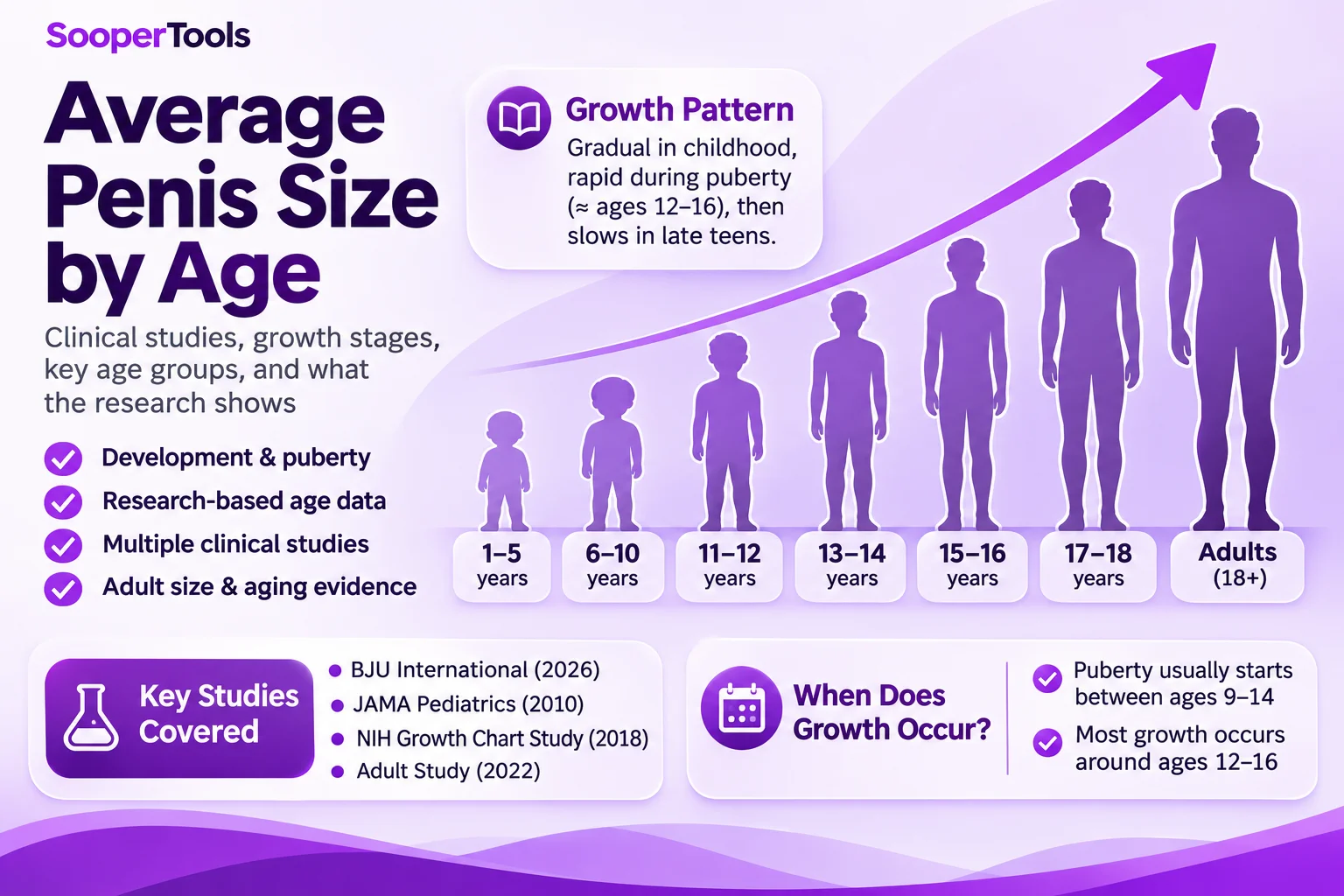
Table of Contents
Average Penis Size by Age: What Clinical Studies Show
Average penis size by age varies throughout childhood, puberty, and adulthood. Clinical research shows that penile development occurs gradually during childhood and becomes more pronounced during puberty. However, there is no single reliable chart that establishes an average erect penis size for every age. Most pediatric studies measure stretched penile length while flaccid, whereas adult studies often report erect measurements. Understanding this difference is essential when interpreting age related statistics.
This guide examines major pediatric growth studies, explains puberty related development, compares published age specific research, and discusses whether measurements change during adulthood.
Written by: SooperTools Editorial Team
Last updated: November 13, 2026
What Does Average Penis Size by Age Mean?
The average penis size by age describes how penile measurements vary across different stages of development. Researchers use clinical measurements to create reference charts that help healthcare professionals understand normal anatomical development.
These measurements are not always the same. Pediatric studies generally use stretched penile length, measured while the penis is flaccid and gently extended. Adult research commonly reports flaccid, stretched, or erect length.
A measurement from one method cannot automatically be compared with a measurement from another.
It is also important to understand that an average represents a group of participants, not a required measurement for every individual of the same age.
How Does Penis Growth Occur During Childhood and Puberty?
Penile development begins before birth and continues after birth. During early childhood, changes are generally gradual. Development becomes more pronounced when puberty begins.
According to the American Academy of Pediatrics, puberty follows an individual timetable. The first noticeable genital changes usually involve enlargement of the testicles and scrotum, followed by penile growth. The penis generally grows in length before increasing in width.
The American Academy of Pediatrics also explains that adult sized genital development may occur between ages 13 and 18.
This means two boys of the same chronological age can be at different stages of physical development. Puberty timing, genetics, and individual biological differences all contribute to this variation.
Read the American Academy of Pediatrics guide to physical development in boys.
Average Penis Size by Age Chart: What Clinical Studies Show
There is no universally accepted US chart providing average erect measurements for every age from birth through adulthood.
However, several clinical studies provide useful developmental reference data.
2026 Pediatric Systematic Review
A systematic review published in BJU International in June 2026 examined 55 studies involving 31,915 boys.
The researchers assessed stretched penile length in pediatric populations and reported the following pooled averages:
| Age group | Average stretched length | 95% confidence interval |
|---|---|---|
| 1 week | 3.07 cm | 2.88 to 3.26 cm |
| 1 year | 3.73 cm | 3.53 to 3.93 cm |
| 2 to 5 years | 4.69 cm | 4.49 to 4.88 cm |
| 5 to 10 years | 5.43 cm | 5.20 to 5.66 cm |
These are pooled mean stretched length measurements, not erect measurements.
The confidence intervals describe uncertainty around each pooled average. They are not the range of measurements expected for every individual child.
The review also identified substantial geographic variation in the research findings, particularly among boys older than two years.
An important limitation is that this review covered prepubertal boys up to age 10. It does not establish a complete puberty or adult growth chart.
Read the 2026 BJU International systematic review.
2010 JAMA Pediatrics Study
A major cross sectional study published in JAMA Pediatrics examined 6,200 clinically healthy males aged 0 to 19 years in Bulgaria.
There were 310 participants in each age group. A physician performed the measurements and recorded stretched penile length, penile circumference, and other developmental measurements.
The following selected results show how the average stretched length changed across the study population.
| Age | Mean stretched length | 5th to 95th percentile |
|---|---|---|
| 10 years | 4.84 cm | 3.66 to 6.00 cm |
| 12 years | 5.86 cm | 4.00 to 8.80 cm |
| 14 years | 8.04 cm | 5.56 to 10.00 cm |
| 16 years | 9.01 cm | 7.20 to 11.00 cm |
| 18 years | 9.07 cm | 7.50 to 11.00 cm |
| 19 years | 9.46 cm | 8.00 to 11.00 cm |
These values describe the Bulgarian study population. They are not official US averages or universal developmental standards.
The researchers observed that penile growth was gradual during childhood, with the period of maximum growth occurring approximately between ages 12 and 16.
The study also found meaningful variation between participants of the same age.
One important methodological detail is that stretched length was measured in the flaccid state using a rigid tape and gentle extension. The measurements were not taken during an erection.
Read the original JAMA Pediatrics study.
2018 Chinese Growth Chart Study
A separate study published in Asian Journal of Andrology examined 2,974 boys aged 0 to 17 years in Chongqing, China.
Researchers developed age specific growth charts and percentile curves for penile length, diameter, and testicular volume.
For 14 year old participants, the study reported:
| Measurement | Result |
|---|---|
| Mean stretched penile length | 8.20 cm |
| Standard deviation | 0.72 cm |
| 3rd to 97th percentile | 6.76 to 9.06 cm |
Measurements were taken while participants were flaccid, using gentle painless extension and a defined anatomical reference point.
The researchers highlighted that boys of the same chronological age can be at different developmental stages. This is particularly important during adolescence.
The study was conducted in China, so its charts should be understood as Chinese population research rather than a US national reference.
Read the 2018 study and its growth charts.
Why Does Penis Size by Age Vary During Puberty?
Chronological age does not determine exactly when puberty begins or how quickly development progresses.
The American Academy of Pediatrics explains that approximately 95% of boys begin puberty between ages 9 and 14. The first signs generally involve testicular enlargement, followed by other physical changes.
Several factors contribute to developmental differences:
- Individual puberty timing.
- Genetic differences.
- Hormonal development.
- General health and nutritional conditions.
- Differences in the populations included in scientific studies.
The Bulgarian and Chinese studies both demonstrate that substantial variation can exist within the same age group.
This is why an age based average should never be interpreted as a fixed expectation for an individual.
When Does Penis Growth Usually Stop?
There is no single age at which every person completes penile development.
The American Academy of Pediatrics reports that adult sized genital development can occur between ages 13 and 18. The exact timing depends on individual development.
The JAMA study found that the period of maximum penile growth in its Bulgarian population occurred approximately between ages 12 and 16. Changes became smaller during later adolescence.
However, this finding should not be interpreted as a universal deadline. Different populations can have different developmental patterns.
The most useful approach is to consider overall puberty development rather than relying on chronological age alone.
For concerns about delayed development, the American Academy of Pediatrics explains when boys should receive an evaluation for delayed puberty.
Does Average Penis Size by Age Change During Adulthood?
Adult research is different from pediatric developmental research.
Pediatric studies examine growth during childhood and adolescence. Adult studies generally investigate existing anatomical measurements and whether these measurements are associated with age or other characteristics.
A prospective study involving 800 adult men in Argentina examined penile measurements and their relationship with anthropometric factors.
The researchers reported the following correlations between age and measurements:
| Measurement | Correlation with age |
|---|---|
| Flaccid length | -0.1 |
| Stretched length | -0.1 |
| Circumference | 0 |
These findings showed little or no correlation between chronological age and the listed measurements within that particular sample.
However, this was a cross sectional study involving men attending urology services. It did not follow the same individuals throughout their lives or establish a separate average measurement for every adult decade.
Therefore, there is not sufficient evidence from this study to produce a reliable universal age based adult size chart.
Read the 2022 prospective study involving 800 men.
Why Is an Age Based Penis Size Chart Sometimes Misleading?
An average penis size by age chart can be useful when it is based on appropriate clinical measurements and clearly identifies its source.
Problems arise when different measurements are combined without explaining their differences.
For example, the following measurements should not be treated as equivalent:
| Measurement | Explanation |
|---|---|
| Flaccid length | Length when the penis is not erect |
| Stretched penile length | Length measured while flaccid and gently extended |
| Erect length | Length during an erection |
| Circumference | Measurement around the shaft |
| Diameter | Measurement across the shaft |
Pediatric growth charts commonly use stretched penile length, while adult research frequently reports erect length.
Combining them into one continuous age based chart can create misleading comparisons.
Geographic differences are another consideration. The Bulgarian, Chinese, and international pediatric studies examined different populations and used different research settings.
A reliable chart must identify the original population, measurement technique, sample size, and statistical method.
How Should Age Related Research Be Interpreted?
Age related research provides useful medical reference information, but it cannot determine an individual’s development from a number alone.
The most useful considerations are:
- The research population and geographic location.
- Whether measurements were stretched, flaccid, or erect.
- The participant sample size.
- The statistical range and variation.
- The developmental stage of the population.
A clinical reference chart is intended to support appropriate medical interpretation. It should not be used as a self assessment or comparison tool for children and teenagers.
Parents or guardians who have concerns about a child’s physical development should discuss them with a pediatrician.
For broader adult research, read Scientific Studies on Average Penis Size.
For population level geographic comparisons, see Average Penis Size by Country.
Key Takeaways
- Average penis size by age describes developmental research, not a fixed measurement for every person.
- Pediatric clinical studies generally measure stretched penile length rather than erect length.
- A 2026 systematic review included 31,915 boys across 55 studies and provided pooled measurements up to age 10.
- A 2010 Bulgarian study and a 2018 Chinese study provide additional age specific growth references.
- Maximum growth in the Bulgarian study occurred approximately between ages 12 and 16.
- Puberty timing differs between individuals, so chronological age alone is not enough to interpret development.
- Adult research does not establish a reliable average measurement for every decade of life.
- Age based charts should always identify their original research, population, and measurement method.
The best way to understand age related development is to examine reliable clinical research in its proper context rather than compare measurements from unrelated charts.
References
- Negri et al. (2026), Paediatric Penile Length: A Systematic Review and Meta Analysis, BJU International
- Tomova et al. (2010), Growth and Development of Male External Genitalia, JAMA Pediatrics
- Wang et al. (2018), Male External Genitalia Growth Curves and Charts for Children and Adolescents
- Solé et al. (2022), Reference Penile Size Measurement and Correlation With Other Anthropometric Dimensions
- American Academy of Pediatrics, Physical Development in Boys
- American Academy of Pediatrics and Pediatric Endocrine Society, Delayed Puberty in Boys
Frequently Asked Questions
1. What is the average penis size by age?
There is no single universal average for every age. Pediatric research generally measures stretched penile length, while adult research often reports erect length. The results must be interpreted separately.
2. Is there a reliable average penis size by age chart?
Yes, clinical studies provide age specific reference charts. However, these charts are based on particular populations and measurement methods. They should not be treated as universal US standards.
3. What is the average penis size for a 14 year old?
The 2018 Chinese study reported a mean stretched penile length of 8.20 cm among its 14 year old participants. This is a research finding from a Chinese population, not a universal standard or an erect measurement.
4. At what age does most penile growth occur?
The 2010 Bulgarian study found that the period of maximum penile growth occurred approximately between ages 12 and 16. The timing can differ between populations and individuals.
5. Does penis growth begin at the same age for everyone?
No. Puberty follows an individual timetable. The American Academy of Pediatrics explains that approximately 95% of boys begin puberty between ages 9 and 14.
6. When does penile growth usually stop?
Adult sized genital development commonly occurs between ages 13 and 18, according to the American Academy of Pediatrics. There is no exact completion age that applies to everyone.
7. Is stretched penile length the same as erect length?
They are different measurement methods. Stretched penile length is measured while flaccid with gentle extension. Erect length is measured during an erection. They should not automatically be treated as identical.
8. Does penis size decrease with age?
Available adult research does not establish a consistent amount of age related size reduction for every individual. A study involving 800 adult men in Argentina found little or no correlation between age and penile circumference.
9. Why do different scientific studies show different measurements?
Differences can result from participant selection, geography, age distribution, measurement locations, research protocols, and statistical methods. Comparisons should always account for these factors.
10. Should age based charts be used to assess a child’s development?
No. General online charts are not substitutes for individual clinical assessment. Concerns about development should be discussed with a qualified pediatrician who can consider growth history and other signs of puberty.