
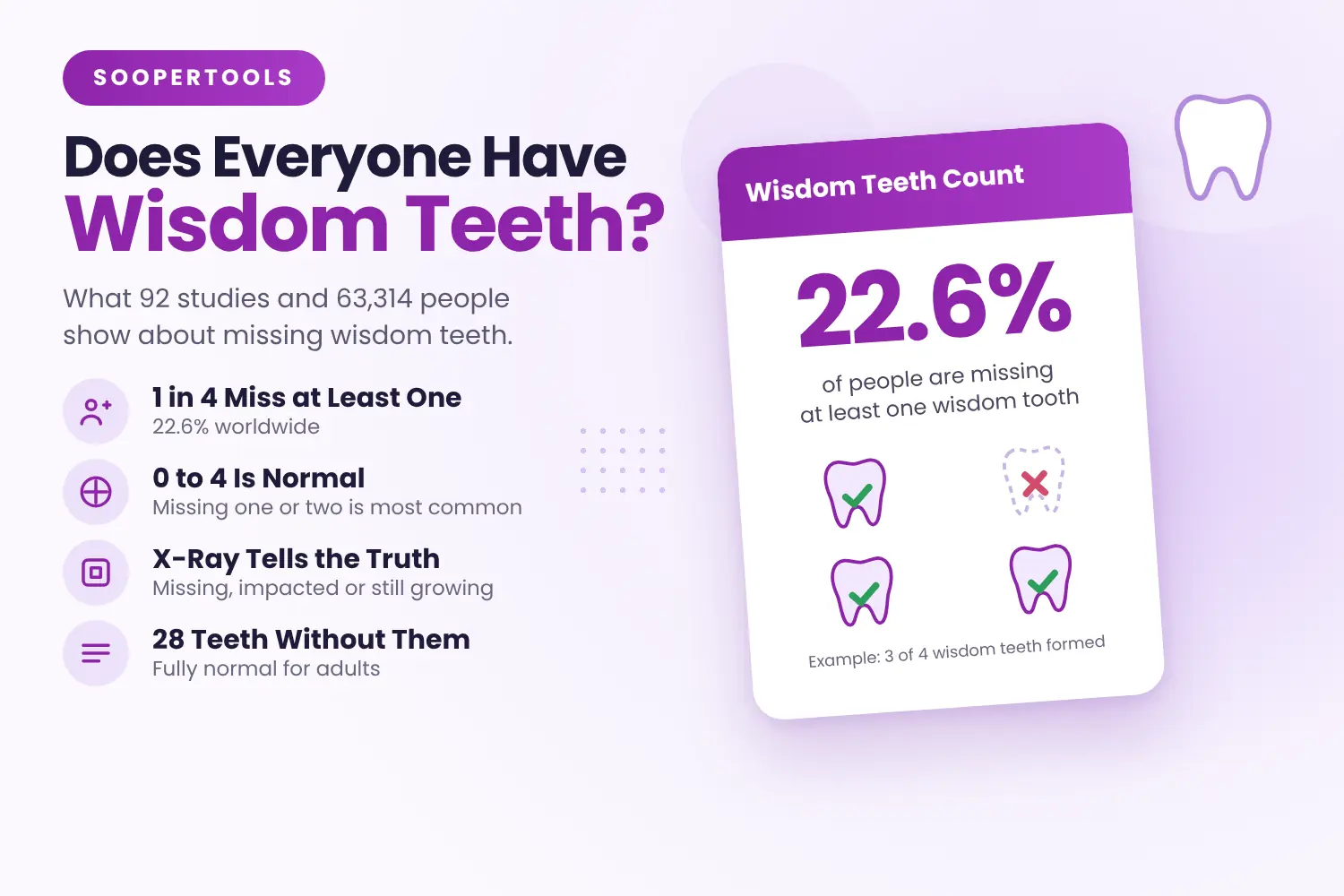
Does Everyone Have Wisdom Teeth? What the Research Shows
Does everyone have wisdom teeth? No. Most adults develop all four, but a large review of 92 studies covering more than 63,000 people found that about 22.6% of people are missing at least one wisdom tooth because it never formed. Missing one or two is the most common pattern, and missing all four is much less common. The only reliable way to know your own count is a dental X-ray, usually taken in the mid-teens.
Table of Contents
Quick Answer: Does Everyone Have Wisdom Teeth?
Not everyone has wisdom teeth. Humans have room for four, one at the back of each side of the upper and lower jaw. Many people develop all four, some develop one to three, and a smaller group develops none at all. Dentists call a tooth that never forms “agenesis”, so a missing wisdom tooth is called third molar agenesis.
If you are a teenager and wonder when yours should appear, the Wisdom Teeth Age Checker shows the typical age range for each stage, from the first bud in the jaw to the tooth coming through the gum. For a full overview of what these teeth are and where they sit, read our guide on what wisdom teeth are.
How Many Wisdom Teeth Do You Have?
How many wisdom teeth do you have? The usual answer is four, but any number from zero to four is normal. A few people even develop extra molars behind the wisdom teeth, called supernumerary teeth or fourth molars, although this is uncommon.
| Number of wisdom teeth | What it means | How common |
|---|---|---|
| 4 | The full set, one in each corner of the mouth | The most common result in most studies |
| 1 to 3 | One or more never formed | Common, about 1 in 5 people worldwide miss at least one |
| 0 | None formed (all four missing) | Much less common, a few percent in many adult studies |
| More than 4 | Extra molars behind the wisdom teeth | Rare |
Results differ from study to study. In a group of Libyan students, 93.5% had all four wisdom teeth and 2.5% had none. In a Japanese clinic study of patients aged 18 and older, 94.8% had at least one wisdom tooth, and 60.7% of that group had all four.
Can You Be Born Without Wisdom Teeth?
Yes, you can be born without wisdom teeth. In a sense everyone is, because wisdom teeth do not exist at birth. They start as a small bud in the jawbone in late childhood. In the Japanese study, the first bud appeared at an average age of 9.4 years, the crown was complete at around 13 to 15 years, and the roots finished forming at around 18 to 23 years.
So “born without wisdom teeth” really means the bud never formed. If no bud shows on an X-ray by the mid to late teens, the tooth will not appear later.
How common is it to be missing wisdom teeth?
The best evidence comes from a 2015 meta-analysis in the Journal of Dental Research by Carter and Worthington. It pooled 92 studies with 63,314 people. The main findings were these.
- 22.63% of people worldwide were missing at least one wisdom tooth.
- Individual studies ranged from 5.32% to 56%, so the rate depends a lot on the group studied.
- Women were 14% more likely than men to be missing at least one.
- Upper wisdom teeth were 36% more likely to be missing than lower ones.
- Missing one or two was the most common pattern. Missing three or four was less common.
What about the claim that 35% of people have no wisdom teeth?
Many websites state that about 35% of people are born without any wisdom teeth. We could not find a large peer-reviewed study behind that number. The worldwide meta-analysis above found that about 22.6% are missing at least one, which includes people missing only one tooth. Missing all four is a smaller group than that.
A few individual studies do report high figures. One study of Indian children aged 9 to 15 found that 24.3% had no sign of any of the four. That group was young, though, and some wisdom teeth only start to form after age 10, so studies of children can count teeth as missing that would appear later. Adult studies, such as the Libyan one above, usually find much lower rates of all four missing.
Why Do Some People Not Have Wisdom Teeth?
Do some people not have wisdom teeth because of their genes, their diet or their jaw size? Researchers point to several factors working together.
- Genetics. A study of twins found missing wisdom teeth more often in identical twins (19.6%) than in non-identical twins (15.5%), which points to a strong inherited part.
- Other missing teeth. In a European study, people who were already missing other adult teeth were missing a wisdom tooth 50.8% of the time, compared with 20.5% of people without other missing teeth.
- Evolution. Human jaws have become smaller over time as diets became softer. Many scientists think this is linked to the trend toward fewer and smaller back molars. You can read more in our article on why we have wisdom teeth.
- Sex and position. Women and the upper jaw show higher rates, as the meta-analysis found.
Does Having Wisdom Teeth Vary by Population?
Yes. The twin study above notes that reported rates of missing wisdom teeth range from about 10% to 41% across countries. Earlier research it reviews reported the lowest values, about 10% to 11%, in some Black African and Indian samples, and the highest reported value was 41% in a Korean group. Differences in study methods explain part of this spread, but ancestry clearly plays a role.
So does everyone have wisdom teeth in every population? No, and the share without them changes from group to group. This also answers a common question, whether people of Asian descent have wisdom teeth. Most do, but several Asian populations show higher rates of one or more missing wisdom teeth than African populations.
Missing, Impacted or Not Grown In Yet?
If you are asking whether everyone has wisdom teeth because you cannot see your own, keep in mind that not seeing a wisdom tooth in your mouth does not mean it is missing. There are four different situations, and only an X-ray can tell them apart.
| Situation | What is happening | How you find out |
|---|---|---|
| Never formed | No bud developed (agenesis) | X-ray shows no tooth in the jaw |
| Impacted | The tooth formed but is trapped under the gum or bone | X-ray shows the tooth below the surface |
| Not erupted yet | The tooth is still moving up, often until the early twenties | X-ray shows a forming tooth |
| Removed | A dentist took it out earlier | Dental records or X-ray |
If you are in your teens or early twenties, a tooth you cannot see may still be on its way. Our guide to the signs of wisdom teeth coming in explains what people usually notice when they start to come through.
How Many Teeth Do Adults Have Without Wisdom Teeth?
How many teeth do adults have without wisdom teeth? The answer is 28. A full adult set has 32 teeth, made up of 8 incisors, 4 canines, 8 premolars and 12 molars, and the 12 molars include the four wisdom teeth.
| Tooth type | With wisdom teeth | Without wisdom teeth |
|---|---|---|
| Incisors | 8 | 8 |
| Canines | 4 | 4 |
| Premolars | 8 | 8 |
| Molars | 12 | 8 |
| Total | 32 | 28 |
Having 28 teeth is completely normal, whether your wisdom teeth never formed or were removed.
Is It Good or Bad to Have No Wisdom Teeth?
Having no wisdom teeth is not a health problem in itself. You chew with the other molars, so most people never notice a difference. People without wisdom teeth also cannot develop impacted wisdom teeth, so they never need the surgery that many others go through. If you do have them and your dentist recommends removal, the Wisdom Teeth Removal Cost Calculator gives a cost estimate and the Wisdom Teeth Recovery Timeline shows what the days after surgery usually look like.
Because a missing wisdom tooth is sometimes linked with other missing adult teeth, your dentist may check the rest of your teeth on the same X-ray. Your own dentist is the right person to explain what your X-ray shows.
7 Key Facts About Missing Wisdom Teeth
- Does everyone have wisdom teeth? No. About 22.6% of people worldwide are missing at least one.
- Missing one or two is the most common pattern. Missing all four is less common.
- Can you be born without wisdom teeth? In a way everyone is, because wisdom teeth start as buds in the jaw from about age 9 or 10.
- Upper wisdom teeth are missing more often than lower ones, and women are missing them slightly more often than men.
- Genes play a strong role, and the rate differs a lot between populations.
- A tooth you cannot see may be impacted or still growing. Only an X-ray can tell.
- Adults without wisdom teeth have 28 teeth, which is completely normal.
References
- Carter K, Worthington S. (2015). Morphologic and Demographic Predictors of Third Molar Agenesis: A Systematic Review and Meta-analysis. Journal of Dental Research. PubMed
- Impact of genetics on third molar agenesis. (2018). Scientific Reports. PMC5974231
- Third molar agenesis in modern humans with and without agenesis of other teeth. (2020). PeerJ. PeerJ 10367
- The Japanese Journal of Pediatric Dentistry. (2019). Radiographic study of third molar development and treatment timing, Volume 57, Issue 1, pages 66 to 79. J-STAGE
- Byahatti S, Ingafou MSH. (2012). Prevalence of eruption status of third molars in Libyan students. Dental Research Journal. PMC3353690
- Mishra A, Pandey RK. (2017). Sexual dimorphism, pattern of third molar and mandibular second premolar agenesis in Indian paediatric orthodontic patients. Saudi Dental Journal. PMC5411905
- Colgate. How Many Teeth Do We Have? Colgate
Written by: SooperTools Editorial Team
Last updated: November 18, 2026
Frequently Asked Questions
1. Is it rare to have no wisdom teeth at all?
It is less common than missing one or two. In many adult studies only a few percent of people have none, although some groups show higher rates. Your dentist can confirm your own count with an X-ray.
2. Do some people not have wisdom teeth even after age 25?
Yes. If a wisdom tooth has not formed by the late teens, it will not form later. Some people who are older than 25 still have wisdom teeth that are trapped under the gum, so an X-ray is the only way to know whether a tooth is missing or hidden.
3. Can you be born without wisdom teeth if your parents were?
You are more likely to be missing wisdom teeth if close family members are, because genes play a strong role. It is not guaranteed, though, and brothers and sisters can have different counts.
4. Is it possible to have only one or two wisdom teeth?
Yes. Missing one or two wisdom teeth is the most common pattern of agenesis in the research. Having one, two or three wisdom teeth is a normal variation.
5. Do you have 4 or 8 wisdom teeth?
People have up to four wisdom teeth, one in each corner of the mouth. Eight is not a normal count. A small number of people develop one or more extra molars, but this is rare.
6. Is 26 too late for wisdom teeth to come in?
Most wisdom teeth come through or become impacted by the early to mid twenties. A tooth that is still trapped can sometimes move later. If you are 26 and see no wisdom teeth, an X-ray will show whether they are present below the gum.
7. Will wisdom teeth grow back after removal?
No. Once a wisdom tooth is removed, it does not grow back. Our article on whether wisdom teeth can grow back explains the rare cases that cause confusion, such as an extra tooth that was already there.
8. Does everyone have wisdom teeth in the upper jaw?
No. Upper wisdom teeth are missing more often than lower ones. The large meta-analysis found that upper wisdom teeth were about 36% more likely to be missing.
9. How many teeth do adults have without wisdom teeth if a tooth was also lost?
Without wisdom teeth an adult has 28 teeth. If other adult teeth were lost or never formed, the count is lower. Your dentist can chart exactly which teeth you have.
10. How many wisdom teeth do you have if you can only see two?
You may still have four. Wisdom teeth that are trapped under the gum or bone do not show in the mouth. A dental X-ray shows how many wisdom teeth you have, including the hidden ones.
11. Why are they called wisdom teeth if not everyone has them?
They are called wisdom teeth because they arrive later than the other teeth, at an age when people were thought to be wiser. The name has nothing to do with how many people have them. Read more in why they are called wisdom teeth.