
CD Ladder vs High Yield Savings
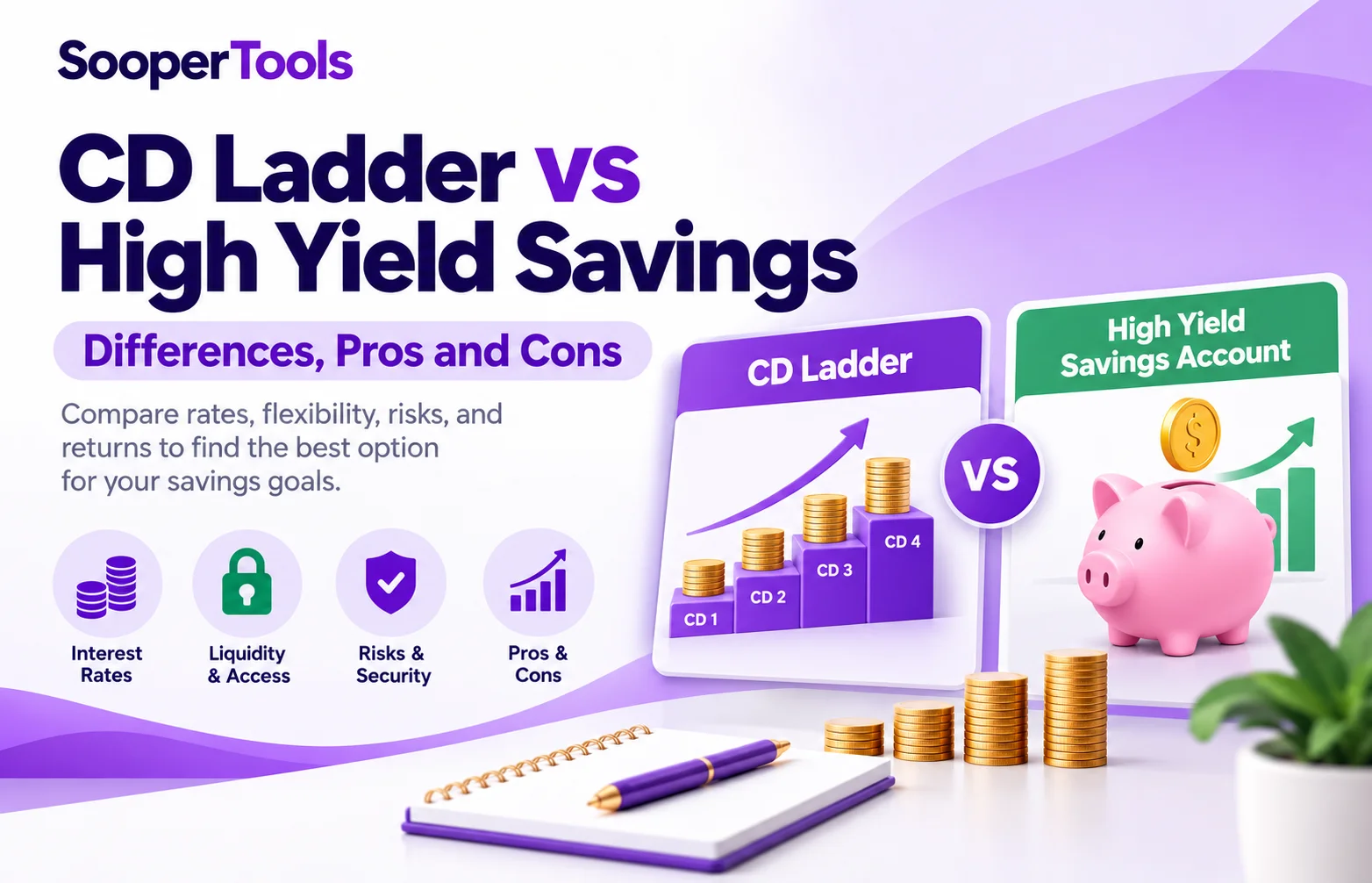
Table of Contents
CD Ladder vs High Yield Savings: Differences, Pros and Cons
A CD ladder and a high yield savings account can both help you earn interest on your savings, but they offer different levels of flexibility and rate certainty. A CD ladder spreads money across certificates of deposit with different maturity dates, while a high yield savings account generally allows easier access to your balance and pays a variable interest rate. The better choice depends on when you need the money, the rates available, and whether you prefer predictable terms or convenient access to cash.
Key takeaway: A CD ladder may suit money assigned to planned future dates, while a high yield savings account may suit money you need to access more readily. You can also use both, keeping near term funds in savings and placing money with longer time horizons into CDs whose terms fit your plans.
What Is the Difference Between a CD Ladder and a High Yield Savings Account?
A certificate of deposit, or CD, is a deposit product that holds your money for a specified term under an agreement with a financial institution. A traditional fixed rate CD generally pays an agreed rate during that term. Taking money out before maturity may trigger an early withdrawal penalty.
A CD ladder divides an investment among several CDs with different maturity dates. When a CD matures, you can use the proceeds or reinvest them, depending on your financial needs and the rates then available.
A high yield savings account is a savings deposit account that pays interest at a rate that can change over time. It typically offers easier access to your money than a traditional CD, subject to the institution’s withdrawal policies, transfer arrangements, and account terms.
The primary difference is not simply the interest rate. A CD ladder lets you spread maturity dates and potentially lock in rates for individual CDs. A high yield savings account generally provides more immediate flexibility, but its rate may rise or fall while your money remains deposited.
CD Ladder vs High Yield Savings: Side by Side Comparison
| Feature | CD Ladder | High Yield Savings Account |
|---|---|---|
| Access to money | Access is organized around CD maturity dates. Early withdrawals may trigger penalties. | Generally offers easier access, subject to account terms, transfer times, and applicable restrictions. |
| Interest rate | A traditional fixed rate CD generally keeps its agreed rate until maturity. | The APY is variable and can change under the account terms. |
| Rate certainty | Provides rate certainty for each fixed rate CD term, not necessarily for the entire ladder indefinitely. | Future interest earnings can change when the account’s APY changes. |
| Early access costs | Traditional CDs may impose early withdrawal penalties. Terms vary by product. | Withdrawals usually do not involve a CD style early withdrawal penalty, but account fees or other restrictions may apply. |
| Maturity dates | Multiple CDs mature on different dates, creating planned opportunities to access or reinvest funds. | There are no CD maturity dates to manage. |
| Reinvestment | Each maturity presents a decision about spending the proceeds or selecting another CD. | You can generally keep the balance in the account without opening a new CD at maturity. |
| Emergency savings | May suit a portion of savings that is not needed immediately. | Often useful for money that needs to remain readily accessible. |
| Deposit insurance | Eligible CDs at FDIC insured banks may be covered within applicable limits. | Eligible savings deposits at FDIC insured banks may also be covered within applicable limits. |
| Management | Requires tracking CD terms, maturity dates, and reinvestment decisions. | Generally simpler to maintain because there are no staggered CD maturities. |
These are general characteristics. Actual rates, withdrawal restrictions, penalties, fees, and insurance eligibility depend on the specific institution and product.
Pros and Cons of a CD Ladder
Advantages of a CD Ladder
- Rate certainty: Traditional fixed rate CDs can provide an agreed rate for each CD term.
- Staggered maturities: You do not need to place all your money into one CD with a single maturity date.
- Planned access: Maturity dates can be arranged around known future expenses, although they do not guarantee access before those dates without potential costs.
- Reinvestment flexibility: As individual CDs mature, you can decide whether to spend the proceeds or select a new term and rate.
- Potential deposit insurance: Eligible bank CDs can qualify for FDIC coverage within the applicable rules and limits.
Disadvantages of a CD Ladder
- Less flexible access: Money in a traditional CD may be subject to an early withdrawal penalty.
- Future rates are uncertain: When a CD matures, available rates may be lower than the rate on the maturing CD.
- More tracking: You must monitor multiple terms, maturity dates, and reinvestment decisions.
- Rate opportunity cost: If savings rates rise, the rate on an existing fixed rate CD may not change until maturity.
- Minimums and restrictions: Some CD products require minimum deposits or have terms that limit how you can use the money.
A CD ladder works best when its maturity schedule reflects when the money may be needed. Choosing longer terms simply because an advertised rate looks attractive can create difficulties if your plans change.
For a step by step explanation of maturity schedules, see the SooperTools CD ladder strategy guide.
Pros and Cons of a High Yield Savings Account
Advantages of a High Yield Savings Account
- Convenient access: You can generally transfer or withdraw money without waiting for a CD to mature, subject to account policies.
- Variable rates can rise: If the institution raises its APY, your subsequent interest earnings may increase without opening a new deposit product.
- Simple management: You do not need to monitor several CD maturity dates or decide whether to roll each one into a new term.
- Useful for short term reserves: The account can hold money intended for unplanned expenses or goals whose timing is uncertain.
- Potential deposit insurance: Eligible deposits at FDIC insured banks can receive coverage under the applicable rules.
Disadvantages of a High Yield Savings Account
- Variable APY: The bank may reduce its rate, so the current return may not continue.
- No guaranteed future rate: You cannot assume that today’s APY will remain available for the months or years ahead.
- Account conditions: Minimum balances, fees, withdrawal procedures, or other terms may affect the overall value of an account.
- Rate monitoring: Although there are no CD maturities, you still need to review the account’s rate and terms as conditions change.
A high yield savings account is not automatically the better choice simply because it is flexible. Its current APY may be lower than the rates available on suitable CDs, and it may fall during the period when you hold the account.
Which Usually Earns More Interest?
Neither a CD ladder nor a high yield savings account consistently earns more. The result depends on the CD rates and terms you select, the savings account’s changing APY, the dates when money is deposited or withdrawn, fees, and the time period being compared.
Comparing a five year CD’s quoted APY with a savings account’s current APY does not establish which option will produce the higher return over five years. The savings rate may change many times during that period, while each traditional fixed rate CD generally retains its agreed rate until maturity.
Compare Equivalent Time Periods
To evaluate the alternatives fairly, consider the amount invested, the intended holding period, the actual CD terms, the savings account’s APY, and the effect of withdrawals or reinvestment. Include relevant fees and consider taxes if you want to compare the money retained after tax.
For CDs, APY reflects the effect of compounding under the product’s assumptions. However, the rate alone does not tell you how much money will be available if you withdraw early or reinvest at a different rate after maturity.
For a high yield savings account, future interest depends on the rates that actually apply during the holding period and how much money remains in the account. An advertised rate should not be treated as a guaranteed future return.
Important: If one option offers a higher rate today, that does not necessarily mean it will earn more over the entire period you intend to save. Compare the full set of terms and separate current rates from assumptions about future rates.
What Happens When Interest Rates Rise or Fall?
Changes in interest rates can influence the two approaches differently. Understanding the possible outcomes can help you choose a structure that matches your preferences.
When Interest Rates Rise
A high yield savings account’s APY may rise when the institution changes its rate. This can help savers benefit from higher rates without closing or reinvesting a CD.
A traditional fixed rate CD generally keeps its contracted rate until maturity. However, a CD ladder has multiple maturity dates, so you may have opportunities to open new CDs at then available rates as individual rungs mature.
When Interest Rates Fall
A high yield savings account’s APY may fall, reducing the interest earned on the balance if the rate remains lower.
Existing fixed rate CDs can continue paying their agreed rate through the end of their terms. When they mature, however, you may need to accept a lower available rate if you choose to reinvest.
Neither strategy eliminates rate uncertainty. A CD ladder provides more certainty for the terms of existing fixed rate CDs, while a high yield savings account offers flexibility as the account’s rate changes.
For a closer look at rate considerations, visit the SooperTools CD ladder rates guide. Any current rate comparison should use verified offers and state when they were checked.
Example: Using a CD Ladder and a High Yield Savings Account Together
Illustrative $20,000 Savings Plan
Suppose a saver has $20,000 and wants to keep some money accessible while assigning the rest to known future needs. One possible illustrative structure is:
- $8,000 in a high yield savings account for expenses that may arise before planned CD maturity dates.
- $12,000 divided among several CDs with staggered maturity dates that correspond to the saver’s expected future needs.
The exact allocation would depend on the saver’s expenses, existing emergency reserves, expected withdrawals, available CD terms, and comfort with restricted access. These figures illustrate how the two products can be combined and are not a recommended allocation for every household.
In this arrangement, the savings account provides an accessible reserve, while the CDs can offer agreed rates for their respective terms. As each CD matures, the saver can decide whether to use the money or reinvest it.
If an unexpected expense is larger than the available savings balance, accessing money still invested in CDs may involve waiting for maturity or paying an early withdrawal penalty. The example therefore works only if the accessible reserve is adequate for the saver’s actual needs.
To model a possible maturity schedule, use the SooperTools CD ladder calculator. It can help estimate CD allocations and projected interest, but it does not predict future savings account rates or guarantee actual returns.
Should You Use a CD Ladder or a High Yield Savings Account for Emergency Savings?
Money intended for emergencies generally benefits from being accessible when needed. A high yield savings account may be useful for this purpose because withdrawals are not tied to CD maturity dates, subject to the account’s conditions and transfer arrangements.
A CD ladder may be suitable for a portion of savings that is not required immediately, provided the maturity dates and early withdrawal restrictions fit the saver’s plans. It should not automatically replace the liquid portion of an emergency reserve.
There is no universal percentage that every household should keep in savings rather than CDs. The appropriate balance depends on income stability, essential expenses, existing liquid assets, dependents, insurance, and the likelihood of needing funds unexpectedly.
For a more detailed discussion of liquidity and emergency reserve structure, read the dedicated CD ladder emergency fund guide.
How to Choose Between the Two Options
Before opening an account or building a ladder, consider the following factors.
- When will you need the money? Funds needed without notice generally call for more accessible arrangements than money assigned to a known future date.
- How much does rate certainty matter to you? A fixed rate CD can establish a rate for its term, whereas a high yield savings account’s APY can change.
- Can you leave the money invested? Check CD early withdrawal provisions and decide how much you can commit without risking a liquidity problem.
- What are the actual rates and terms? Compare available APYs, CD terms, minimum deposits, account fees, and transfer conditions rather than choosing based on a headline rate.
- How will you handle maturity dates? Decide whether you will spend CD proceeds or reinvest them and how you will respond if rates change.
- Is the product eligible for deposit insurance? Verify the financial institution and understand how account balances are combined for coverage purposes.
For a comparison made in 2026, use the rates and product terms available when you are actually considering opening an account. Rates can change, so an older example should not be treated as a current offer.
If you are comparing a CD ladder, a high yield savings account, and bonds in 2026, remember that bonds are investments rather than FDIC insured deposits. Their market value and risks depend on the bond type, issuer, and time remaining until maturity.
Deposit Insurance and Important Limitations
Eligible savings accounts and CDs at FDIC insured banks can receive deposit insurance. The standard limit is $250,000 per depositor, per insured bank, per account ownership category. The FDIC combines eligible deposits held in the same ownership category at the same bank when determining coverage.
Opening multiple CDs or separating money across several accounts at the same bank does not automatically create separate coverage for every account. Coverage depends on account ownership, the institution, and applicable insurance rules.
Products offered through brokerage platforms can have different structures. Before assuming that a product qualifies for FDIC coverage, confirm the issuing institution, deposit status, and applicable terms.
The FDIC explains covered deposit products and insurance limits in its official deposit insurance guidance.
Frequently Asked Questions
Is a CD ladder better than a high yield savings account?
It depends on your needs. A CD ladder can provide fixed rates for individual terms and staggered maturity dates. A high yield savings account generally provides easier access to cash but has a variable APY. The appropriate option depends on your timeframe, liquidity requirements, and the actual rates and terms available.
Can I withdraw money from a CD ladder whenever I want?
Access depends on the type of CD and its agreement. Traditional CDs may permit early withdrawal with a penalty, while some products have other restrictions. A ladder provides planned access through staggered maturity dates, but it does not guarantee penalty free access at any time.
Can a high yield savings account earn more than a CD ladder?
Yes, it can, depending on the savings account’s changing APY and the CD rates and terms selected. It can also earn less. A fair comparison considers the full holding period, deposit and withdrawal timing, fees, and reinvestment assumptions rather than comparing only the rates advertised today.
Can I use both a CD ladder and a high yield savings account?
Yes. You can keep money needed for near term expenses in a savings account and place other funds in CDs with maturity dates suited to planned future needs. The allocation should reflect your likely expenses, accessible reserves, account terms, and comfort with committing money for a fixed period.
What happens if interest rates rise after I open a CD?
A traditional fixed rate CD generally keeps its contracted rate until maturity, so it may not benefit immediately from higher rates. A high yield savings account’s APY may rise if the institution changes its rate. When a CD matures, you can review new offers, but future rates are not guaranteed.
Are high yield savings accounts and CDs FDIC insured?
Eligible savings accounts and CDs at FDIC insured banks are covered within applicable insurance limits and ownership rules. The standard limit is $250,000 per depositor, per insured bank, per ownership category. Check the institution and account structure rather than assuming that every product marketed as a CD or savings account qualifies.
Should I keep my emergency savings in a CD ladder?
Money needed for unexpected expenses should generally remain accessible. A high yield savings account may be more convenient for that purpose, while a CD ladder may suit a portion of funds that can remain committed until planned maturity dates. The right balance depends on your expenses, income stability, and other liquid resources.
Related Tools
These tools can help you estimate the CD portion of your savings decision.
CD Ladder Calculator
Model CD allocations, terms, maturity dates, and estimated interest across a ladder.
CD Calculator
Estimate CD interest and maturity value using a deposit amount, APY, and term.
CD Maturity Calculator
Estimate an individual CD’s maturity date and projected value using the information you enter.
Final Thoughts
A CD ladder and a high yield savings account serve different purposes. A CD ladder can provide rate certainty for individual terms and planned maturity dates, while a high yield savings account typically makes money easier to access at a variable rate.
You do not necessarily need to choose only one. A combination can help separate money intended for immediate access from funds assigned to future dates. Compare the actual rates, terms, withdrawal conditions, and insurance eligibility before deciding how to allocate your savings.
This article provides general financial education, not individualized financial advice. Your choice should reflect your circumstances, planned expenses, and ability to access other funds when needed.
Authoritative References
- Federal Deposit Insurance Corporation: Understanding Deposit Insurance. Explains eligible deposit products, standard coverage limits, and account ownership categories.
- Federal Deposit Insurance Corporation: Your Insured Deposits. Describes which deposit products the FDIC insures and which financial products are not covered.