
Penis Size By Country
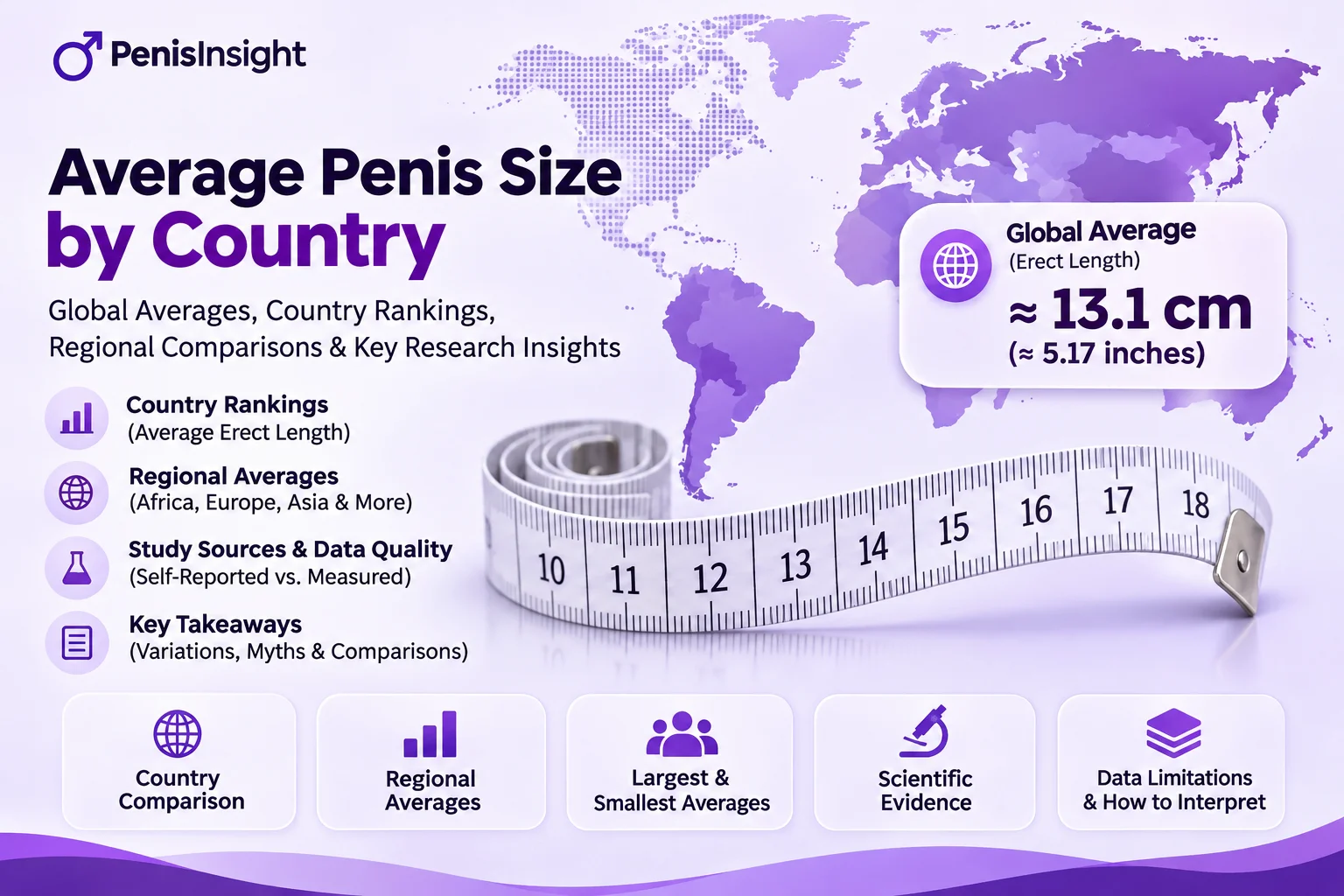
Table of Contents
Average Penis Size by Country: Rankings, Scientific Studies, and Data
The average penis size by country varies across online rankings, but there is no single scientifically established ranking that measures every country using the same method. International comparison websites publish different figures because they combine studies with different sample sizes, measurement techniques, populations, and research dates. This guide compares the figures published by major data sources and explains what scientific studies can actually tell us.
Average Penis Size by Country: Comparing Three Major Sources
Several websites publish country by country comparisons of average erect penis length. Three frequently referenced sources are World Population Review, WorldData.info, and DataPandas.
Their published figures do not always agree. The following table compares selected countries to illustrate these differences. All measurements are in centimeters.
| Country | World Population Review | WorldData.info | DataPandas |
|---|---|---|---|
| Ecuador | 17.59 | 17.61 | 17.59 |
| Sudan | 17.95 | 16.47 | 16.65 |
| DR Congo | 17.93 | 14.48 | 16.63 |
| Cameroon | 16.65 | 16.67 | 15.35 |
| United States | 14.15 | 13.58 | 12.85 |
| United Kingdom | 14.30 | 13.13 | 14.30 |
| India | 12.93 | 13.72 | 12.93 |
| China | 12.90 | 12.43 | 12.90 |
| Japan | 12.60 | 13.56 | 11.30 |
| Pakistan | 11.40 | 12.20 | 11.40 |
| Thailand | 9.43 | 11.45 | 9.43 |
Sources: World Population Review, WorldData.info, and DataPandas. Figures reflect the values displayed by these publishers when reviewed. They are not independently verified national clinical averages.
The differences are important. For example, World Population Review lists Sudan at 17.95 cm, while WorldData.info lists it at 16.47 cm. For DR Congo, the published figures range from 14.48 cm to 17.93 cm.
These differences show why a country ranking should be read alongside its source and methodology rather than treated as a precise scientific measurement.
Which Countries Have the Largest Reported Averages?
The highest positions depend on the dataset being used.
World Population Review’s 2026 country ranking lists Sudan, DR Congo, Ecuador, and the Republic of the Congo among the countries with the highest reported erect length figures. DataPandas places Ecuador, the Republic of the Congo, and Nigeria at the top of its published 2014 dataset. WorldData.info also places Ecuador at the top, followed by Cameroon and Bolivia.
These are rankings from separate compilations, not results from one international clinical study.
Ecuador is a useful example. Its reported average is close to 17.6 cm across all three sources. However, agreement between websites does not necessarily mean that each source conducted an independent measurement study. Sources can reuse earlier research or secondary datasets.
The country listed at number one should therefore be described as having the highest reported figure in a particular dataset, rather than the highest scientifically proven national average.
Which Countries Have the Smallest Reported Averages?
The lower end of the rankings also varies by source.
World Population Review lists Thailand, North Korea, Cambodia, and Nepal among the countries with the lowest reported values. DataPandas also places Thailand at the bottom of its erect length dataset, followed by North Korea and Cambodia.
WorldData.info reports different figures for several of these countries. For example, its published average for Thailand is 11.45 cm, compared with 9.43 cm in World Population Review and DataPandas.
This disagreement should not be interpreted as proof that one country’s population has a particular physical characteristic. The underlying samples may differ in age, recruitment, measurement procedure, and research period.
What Do Scientific Studies Say About the Global Average?
Country rankings and clinical research answer different questions. A global clinical review combines data from studies that meet specified research criteria, while a country ranking attempts to compare populations across different locations.
Two major research reviews provide useful global reference figures.
The 2015 systematic review
A systematic review published in BJU International by Veale and colleagues examined measurements from up to 15,521 men. The researchers included studies where measurements were performed by health professionals using a standard procedure.
The review reported an average erect length of 13.12 cm, based on 692 erect measurements. It also reported an average stretched length of 13.24 cm from 14,160 measurements.
The sample sizes are different because not every participant had every type of measurement. The 13.12 cm figure should not be described as though all 15,521 men were measured while erect.
Read the 2015 systematic review on PubMed.
The 2023 global meta analysis
A separate systematic review and meta analysis published in 2023 evaluated 75 studies involving 55,761 men. It reported a pooled average erect length of 13.93 cm, with a 95% confidence interval of 13.20 to 14.65 cm.
The researchers also identified variation between geographic regions and across measurement periods.
This result is not directly interchangeable with the 2015 review. The studies included, dates, and analysis methods differ.
Read the 2023 meta-analysis on PubMed.
Together, these reviews provide useful clinical reference points. Neither establishes a standardized ranking for every country.
What Country Specific Scientific Studies Actually Show
Some countries have research that provides more specific information than a general international ranking.
For example, a 2024 meta analysis of Chinese men’s penile size combined 23 studies involving 34,060 men. It reported a mean erect length of 12.42 cm and an average erect circumference of 10.75 cm.
The research also compared its Chinese dataset with an international reference population. It found no statistically significant difference in erect length between the two groups.
This is more informative than simply copying a number from a country ranking website because the study explains its research population, sample size, and analysis.
However, a study of Chinese participants cannot automatically represent every person in East Asia. Similarly, research conducted in one hospital or city should not automatically be treated as representative of an entire country.
Read the Chinese men’s penile-size meta-analysis.
Why Do Average Penis Size Statistics Differ Between Countries?
There are several reasons why websites publish different country averages.
1. Different measurement methods
Studies do not always use the same measurement procedure. Some measure erect length, while others measure stretched or flaccid length.
The starting point can also differ. A measurement taken from the pubic bone to the tip is not necessarily equivalent to one taken from the skin junction to the tip.
The European Association of Urology explains that penile measurement methods have not been fully standardized and that no universal consensus definition exists across the research literature.
2. Clinical measurements versus self reported figures
A clinician measured study and an online survey do not provide the same type of evidence.
Clinical studies use a defined measurement procedure. Self reported surveys depend on participants measuring and reporting their own results, which can introduce measurement and reporting errors.
Some published rankings combine these types of information. DataPandas, for example, states that its compilation includes both clinician measured studies and self reported surveys. It also states that it applies adjustments to self reported values.
Those adjustments are part of that publisher’s methodology. They do not eliminate differences in the original samples or make every entry equivalent to a clinical study.
3. Different sample sizes
A country average based on hundreds or thousands of participants has a different level of statistical support from one based on a few dozen participants.
A small sample can be affected by the characteristics of the people who volunteered. It may not represent the wider population.
For this reason, sample size should be displayed alongside a reported national average whenever the original study provides it.
4. Different research years
A page updated in 2026 does not necessarily contain measurements collected in 2026.
DataPandas labels its erect length dataset as 2014 data, although the ranking page itself shows a March 2026 update date. World Population Review currently labels its page as a 2026 ranking, but its figures are compiled from studies conducted at different times.
The publication date and the underlying study date should always be considered separately.
How to Judge Whether a Country Ranking Is Reliable
Before relying on an international comparison, check the information behind each reported figure.
| Evidence to check | Why it matters |
|---|---|
| Original research | Helps establish where the number came from |
| Study year | Shows when participants were measured |
| Sample size | Indicates how many people were included |
| Measurement method | Identifies how length or circumference was measured |
| Measurement state | Distinguishes erect, stretched, and flaccid measurements |
| Population | Explains who participated in the study |
| Data collection method | Separates clinical measurement from self reporting |
| Limitations | Identifies possible sampling or measurement problems |
A source that provides these details makes its figures easier to evaluate. A table containing only country names and measurements does not provide enough information to judge the quality of every entry.
Can Country Averages Predict an Individual’s Size?
No. A country average describes a group level statistic. It cannot determine the measurement of an individual.
There is natural variation among individuals within every population. A reported national average is not a minimum, maximum, medical standard, or prediction for a particular person.
Country rankings should not be used to judge individuals, make assumptions about ethnicity, or draw conclusions about someone’s health or sexual performance.
A person’s measurement is best understood using a consistent measurement method and an appropriate clinical reference, rather than comparing it with a country ranking.
For further reading, see the guide to scientific studies on average penis size and the general penis size percentile guide.
Understanding the Data Before Comparing Countries
The available country rankings can help readers explore how different publishers present international measurements. However, they should not be interpreted as a definitive scientific ordering of national populations.
The strongest approach is to keep reported country figures separate from clinical research, identify the source of each number, and explain differences in measurement methods and samples. When a national estimate cannot be traced to suitable research, its limitations should be made clear instead of presenting it as a verified fact.
For anyone interested in understanding an individual measurement, the Penis Size Calculator provides a separate way to explore measurement and percentile information.
References and Data Sources
- Veale et al. (2015), BJU International: Systematic review and nomograms
- Belladelli et al. (2023), Worldwide Temporal Trends in Penile Length
- A Meta-analysis of Chinese Men’s Penile Size in a Global Context (2024)
- European Association of Urology: Penile Size Abnormalities and Measurement Guidance
- World Population Review: Penis Size by Country
- WorldData.info: International Penis Sizes Compared
- DataPandas: Penis Size by Country
- Visual Capitalist: Mapped Average Penis Length by Country
Frequently Asked Questions
1. Which country has the highest average penis size?
The answer depends on the dataset. World Population Review currently lists Sudan at 17.95 cm, while WorldData.info and DataPandas list Ecuador at approximately 17.6 cm. These are reported figures from separate compilations, not a definitive clinical ranking.
2. Which country has the smallest reported average penis size?
World Population Review and DataPandas list Thailand at 9.43 cm in their erect length rankings. WorldData.info reports a higher figure of 11.45 cm. The difference illustrates why the source and methodology should always be checked.
3. What is the average penis size worldwide?
Clinical research reviews report different pooled estimates. The 2015 Veale review reported 13.12 cm for erect length, while a 2023 meta analysis reported 13.93 cm. These figures come from different study collections and should not be treated as one universally agreed value.
4. Are average penis size by country rankings based on scientific studies?
Some country figures are based on published clinical studies, while others come from self reported surveys or secondary data compilations. The evidence quality varies by country. A reliable comparison should identify the original study, sample size, and measurement method.
5. Why do different websites show different country averages?
Websites may use different source studies, sample populations, research years, and measurement methods. Some combine clinician measured results with self reported figures. These differences can produce substantially different country averages.
6. Are erect and stretched penis measurements the same?
No. Erect length is measured during an erection, while stretched length is measured by gently extending the penis when flaccid. Research should identify which measurement state was used because the two measurements are not interchangeable.
7. Is the average penis size in the United States different across ranking websites?
Yes. The figures displayed by the three sources compared in this article are 14.15 cm for World Population Review, 13.58 cm for WorldData.info, and 12.85 cm for DataPandas. These values should be understood as publisher reported estimates rather than one verified national average.
8. Are country averages based on the same number of participants?
No. Sample sizes differ between studies and countries. Some research includes large clinical populations, while other studies have relatively few participants. Small samples may not accurately represent an entire national population.
9. Does a country average predict an individual’s penis size?
No. A group average cannot determine an individual’s measurement. There is substantial individual variation within every population, so country level comparisons should not be used to make assumptions about a particular person.
10. How can I check whether a penis size measurement is accurate?
Use a consistent measurement method and record whether the measurement is erect, stretched, or flaccid. The starting point and measurement position should also remain consistent. See the guide to measuring penis length and girth correctly for practical measurement instructions.