
How to Measure Penis Correctly
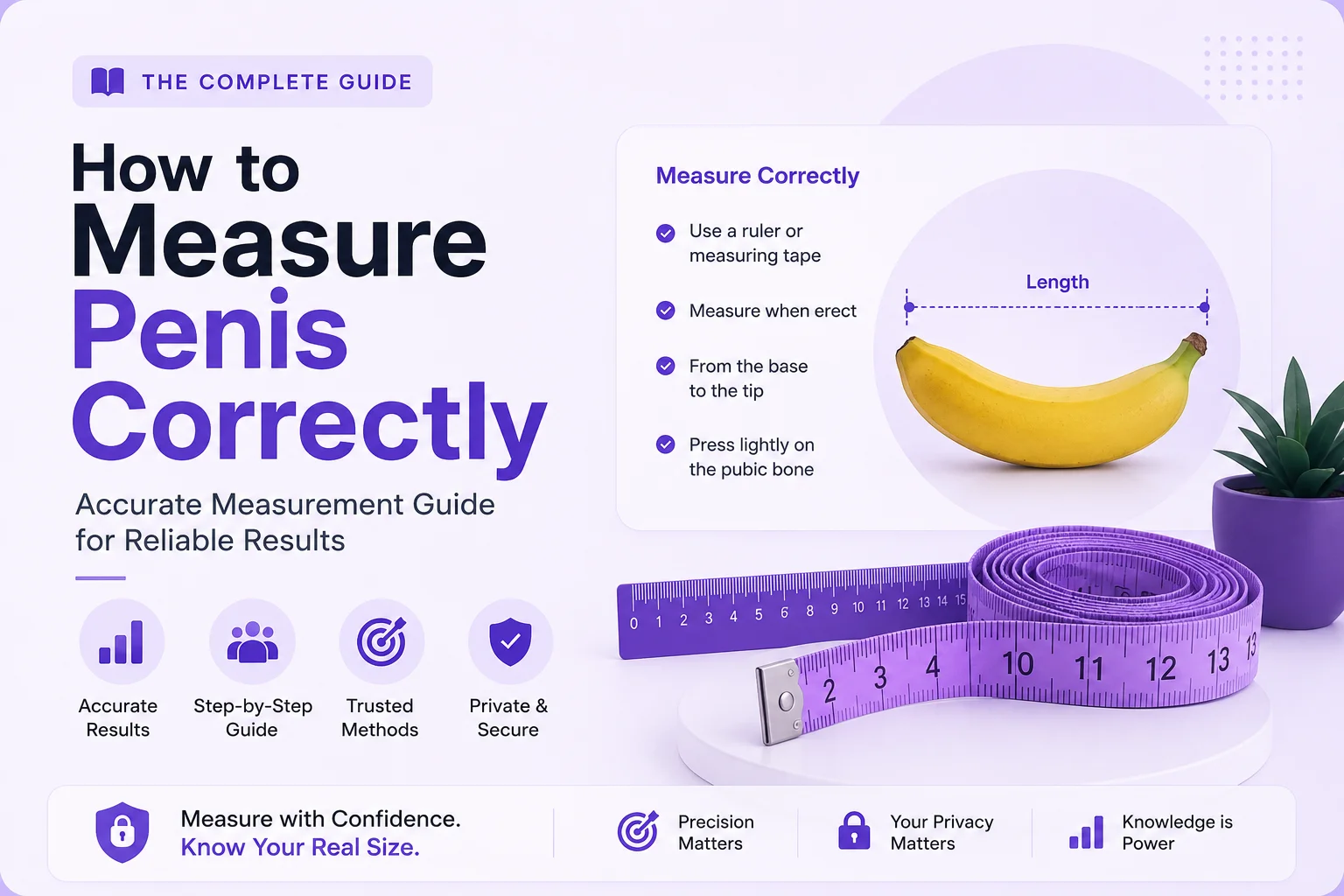
Table of Contents
How to Measure Penis Correctly: 5 Easy, Essential Steps
To measure penis length and girth correctly, use a suitable ruler or flexible measuring tape, select clear anatomical reference points, and repeat the same method consistently. Length is measured from the base to the tip of the glans, while girth is the circumference around the shaft. For accurate penis measurement, you must also record the measurement state, starting point, girth location, and unit. These details help prevent common errors and make later comparisons more meaningful.
Quick Answer: How Should You Measure Correctly?
For a personal length measurement, use a ruler along the upper side of the shaft and decide whether you are recording skin to tip length or bone pressed length. For girth, use a flexible, non stretch measuring tape around a clearly identified location on the shaft. Record whether the measurement is erect, flaccid, or stretched. Do not treat these different measurement methods as interchangeable.
What You Need Before Measuring
You do not need specialized equipment for a basic personal measurement. A few simple items are sufficient:
- A rigid or semi rigid ruler for straight line length measurement.
- A flexible, non stretch measuring tape for girth or circumference.
- A private record where you can note the measurement and the method used.
- A consistent approach to starting points, measurement state, and units.
Choose the instrument according to the measurement you are taking. A rigid ruler is convenient for straight line length, while a flexible tape is designed to follow the circumference of the shaft.
Avoid elastic or stretchable tape because it can change length under tension. Do not estimate measurements visually or switch between instruments without recording the difference.
How to Measure Penis Length Correctly
Penis length can be measured in the erect, flaccid, or stretched state. Each describes a different condition. The most important thing is to identify the state and use the same method when comparing readings.
Step 1: Choose Your Starting Point
There are two commonly described approaches to measuring length.
| Method | Starting point | Important detail |
|---|---|---|
| Skin to tip (STT) | Where the penile shaft meets the body | The reading can be affected by the tissue around the base |
| Bone to tip (BTT), also called bone pressed length | The pubic bone at the base | The ruler is gently pressed through the surrounding tissue toward the bone |
Neither method should automatically be treated as the only valid measurement method. The European Association of Urology describes both skin junction to tip and pubic bone to tip approaches in its clinical guidance.
For personal tracking, choose one reference point and record it. If a healthcare professional or research study specifies a particular method, follow that protocol rather than substituting another one.
Step 2: Position the Ruler Correctly
For a dorsal, or upper side, length measurement, align the ruler with the shaft and keep it straight. Make sure the scale begins at the reference point you selected.
For a bone pressed measurement, apply gentle pressure toward the pubic bone. Do not press forcefully or continue if the process causes pain.
Keep the ruler aligned with the same measurement path each time. Switching between upper side and underside measurements can produce readings that are difficult to compare. Clinical protocols may use different anatomical directions, so a personal method should not be presented as a universal clinical standard.
Step 3: Measure to the Tip of the Glans
Read the ruler at the tip of the glans, which is the head of the penis. Do not extend the measurement beyond the glans to include foreskin that projects past it.
Record the number and its unit. For example, write 13.2 centimeters or 5.2 inches rather than recording an unlabeled number.
Step 4: Record the Measurement State
Always identify whether the measurement was taken when erect, flaccid, or stretched.
These states are not interchangeable. A flaccid measurement is not automatically an incorrect measurement, but it should not be compared directly with an erect measurement as though both represent the same quantity.
For more detail about the differences between these states, see Erect vs. Flaccid Measurement.
How to Measure Penis Girth Correctly
Penis girth means the circumference around the shaft. It is not the width or diameter measured straight across.
A flexible, non stretch measuring tape is the most convenient tool for a personal girth measurement.
Step 1: Select a Consistent Location
The circumference can differ at different points along the shaft. For a repeatable personal measurement, the middle of the shaft is a practical reference location.
Clinical assessments may record more than one location, including the proximal area near the base, the middle of the shaft, and the distal area near the head. The European Association of Urology describes these locations in its clinical measurement guidance.
The important point for personal tracking is to record the location. A measurement taken near the base should not be compared as though it were identical to one taken at mid shaft.
Step 2: Wrap the Measuring Tape Around the Shaft
Place the flexible tape around the selected location. Keep it level and snug enough to contact the skin without compressing the tissue.
Read the number where the tape meets itself. That measurement is the circumference.
Do not pull the tape tightly into the skin. Excessive pressure can reduce the circumference reading. A loose or angled tape can also make the result unreliable.
Step 3: Record the Details
A useful measurement record should include the following information:
| Record field | Example |
|---|---|
| Measurement type | Girth or circumference |
| Location | Mid shaft |
| State | Erect or flaccid |
| Unit | Inches or centimeters |
| Instrument | Flexible, non stretch tape |
| Tape tension | Snug without compression |
This information makes it easier to understand what a measurement represents when reviewing it later.
How to Convert Inches to Centimeters
You can record length and girth in either inches or centimeters. The conversion is straightforward:
- Inches to centimeters: multiply by 2.54.
- Centimeters to inches: divide by 2.54.
For example, a measurement of 5 inches converts to 12.7 centimeters.
5 × 2.54 = 12.7 cm
Likewise, 12.7 centimeters converts to 5 inches.
12.7 ÷ 2.54 = 5 inches
These are exact unit conversions. They do not make the original physical measurement more precise. Avoid rounding too early when comparing two values, and use a consistent level of precision in your records.
Common Penis Measurement Mistakes and How to Avoid Them
Many measurement errors happen because the person changes the method without noticing. A ruler can display a number correctly while the recorded result is still misleading because the starting point, measurement state, or location was different.
The following errors are especially important to understand.
1. Mixing Skin to Tip and Bone to Tip Measurements
A skin to tip measurement begins where the shaft meets the body. A bone to tip measurement begins at the pubic bone after gentle pressure through the surrounding tissue.
These methods can produce different readings. Mixing them when tracking measurements can make it appear that the length has changed when the method has simply changed.
Choose one method for personal comparisons and label it clearly.
2. Pressing Too Hard Against the Pubic Bone
The bone pressed method uses gentle pressure to reach the pubic bone through the surrounding tissue. It does not require excessive force.
Pressing painfully or inconsistently does not improve the quality of the measurement. Use the same gentle technique each time.
3. Measuring Along Different Directions
Switching between the upper side, underside, or a diagonal path can change the recorded length. Some clinical protocols use different anatomical approaches, but a personal measurement record should identify the path used.
For repeatable home tracking, choose a clearly defined path and keep it consistent.
4. Using an Unsuitable Measuring Tool
A rigid ruler is practical for straight line length, while a flexible measuring tape is appropriate for circumference.
Trying to measure girth with a straight ruler does not provide a circumference measurement. Similarly, an elastic tape may stretch and change the reading.
Use a tool suited to the measurement rather than assuming one instrument works equally well for every purpose.
5. Pulling the Girth Tape Too Tightly
The tape should touch the skin without compressing the shaft. Excessive tension can reduce the recorded circumference.
A loose, twisted, or angled tape can produce a different problem. Keep it level and apply consistent, gentle tension.
6. Changing the Girth Measurement Location
A circumference measurement near the base may differ from one at the middle or closer to the head.
This does not necessarily mean that one reading is wrong. It may simply describe a different location.
Record the location every time. Do not compare measurements from different shaft positions without accounting for that difference.
7. Treating Flaccid and Erect Measurements as the Same
Flaccid, stretched, and erect measurements describe different states. Recording a flaccid measurement is not itself a mistake.
The mistake is comparing it directly with an erect reference or changing measurement states between personal records without labeling the change.
The differences between these states are explained in Erect vs. Flaccid Measurement.
8. Measuring to the Wrong Endpoint
For a length measurement, the endpoint is the tip of the glans. Including foreskin that extends beyond the glans can change the recorded value.
Identify the endpoint before reading the ruler, and use the same endpoint each time.
9. Switching Units or Rounding Inconsistently
Recording one value in inches and another in centimeters without converting correctly can lead to comparison errors.
The same problem can occur when one reading is rounded heavily and another is recorded to a decimal place.
Record the original unit, convert using 2.54 centimeters per inch, and apply a consistent level of precision.
10. Assuming Every Published Study Uses the Same Method
Scientific and clinical measurement protocols are not identical. Some studies use skin to tip measurements, some use bone to tip measurements, and others use stretched or flaccid states.
The European Association of Urology states that penile measurement methods have not been universally standardized and that substantial variation exists in the way studies report measurements.
A personal measurement should therefore be compared only with reference data that uses a sufficiently similar method and measurement state.
What Research Says About Measurement Accuracy
Two research publications help explain why measurement methods and observer consistency matter.
The 2018 Habous Study
Habous and colleagues published a study examining differences in penile measurement technique and accuracy. It included 201 adult men, with a mean age of 49.4 years, who were assessed by seven experienced andrology specialists in controlled clinical conditions.
The researchers recorded skin to tip length, bone to tip length, and circumference in the stretched flaccid state. They then repeated measurements during a fully induced erection.
In that particular clinical sample, stretched flaccid measurements underestimated the corresponding erect measurements by averages of approximately 23.39% for skin to tip length, 19.86% for bone to tip length, and 21.38% for circumference.
These figures should not be used as a universal correction factor. The study used a selected clinical population, a defined measurement protocol, and medically induced erections. It demonstrates why measurement state and method matter, not that every person’s flaccid measurement is exactly 20% lower.
Read the full Habous et al. study.
The 2021 Systematic Review
Cakir and colleagues reviewed 70 studies of penile length measurement to examine differences in reported methodology.
Approximately 90% of the studies reported measurements performed by healthcare practitioners in clinical settings. A semi rigid ruler was the most commonly reported instrument, appearing in 62.86% of the reviewed studies.
The review identified differences in patient position, measurement instruments, anatomical landmarks, measurement state, and examiner.
This matters because two values taken using different protocols may not be directly comparable, even when both were recorded carefully.
Read the 2021 systematic review of penile length measurement methods.
How to Improve Penis Measurement Accuracy
A reliable personal record depends on consistency rather than repeatedly measuring in search of a preferred number.
Use these practices:
- Choose one length reference method and record whether it is skin to tip or bone to tip.
- Use the same measurement state when comparing readings.
- Keep the ruler aligned with the same measurement path.
- Use a flexible, non stretch tape for circumference.
- Record the girth location and avoid compressing the tissue.
- Use the same units or convert values correctly.
- Record individual readings rather than selectively keeping the largest result.
- Do not assume that every small difference reflects an anatomical change.
A simple record can look like this:
| Measurement detail | Your record |
|---|---|
| Length | Enter your recorded value |
| Length method | Skin to tip or bone to tip |
| Length state | Erect, flaccid, or stretched |
| Girth | Enter your recorded value |
| Girth location | Base, mid shaft, or distal |
| Girth state | Erect or flaccid |
| Unit | Inches or centimeters |
| Instrument | Ruler or flexible tape |
| Date | Record the measurement date |
How to Interpret Your Measurements
A measurement describes a particular dimension recorded using a particular method. It does not, by itself, establish a medical diagnosis or explain how someone compares with every published reference group.
Before comparing your result with scientific averages or percentile information, check whether the reference uses the same measurement state, anatomical landmarks, and type of measurement.
For research context, read Scientific Studies on Average Penis Size.
To understand how a recorded value compares with the reference data supported by the site, visit the Penis Size Percentile Guide.
You can also enter your measurements into the Penis Size Calculator. The calculator can work with the values you provide, but it cannot verify whether the physical measurement was performed correctly. Its output should not be treated as a clinical assessment.
If you notice a new change in shape, pain, or another concerning symptom, speak with a qualified healthcare professional rather than relying on repeated home measurements.
Conclusion
To measure penis length and girth correctly, choose clear reference points, use suitable instruments, record the measurement state, and keep your method consistent. Length and circumference describe different dimensions, and measurements taken at different locations or in different states should not be treated as interchangeable.
The most useful record is not simply a number. It is a number accompanied by the method, location, state, and unit used to obtain it.
References
- European Association of Urology: Penile Size Abnormalities and Dysmorphophobia
- Habous et al. (2018): Outcomes of Variation in Technique and Variation in Accuracy of Measurement in Penile Length Measurement
- Cakir et al. (2021): Penile Length Measurement: Methodological Challenges and Recommendations, a Systematic Review
Frequently Asked Questions
1. How do you measure penis length correctly?
Use a ruler along the upper side of the shaft, choose a clearly defined starting point, and measure to the tip of the glans. Record whether the method was skin to tip or bone to tip and whether the measurement was erect, flaccid, or stretched.
2. What is the difference between skin to tip and bone pressed length?
Skin to tip measurement begins at the point where the shaft meets the body. Bone pressed measurement begins at the pubic bone after gentle pressure through the surrounding tissue. The two methods can produce different readings and should be recorded separately.
3. Should you press the ruler against the pubic bone?
For a bone to tip measurement, the ruler is gently pressed toward the pubic bone. The pressure should be controlled and should not cause pain or injury. A skin to tip measurement uses a different starting point.
4. How do you measure penis girth correctly?
Wrap a flexible, non stretch measuring tape around the selected shaft location. Keep the tape level and snug without compressing the tissue. Record the location and measurement state along with the circumference.
5. Where should you measure penis girth?
For a consistent personal record, the middle of the shaft is a practical reference location. Clinical assessments may record circumference at the base, mid shaft, and distal area. Always record the location used.
6. Is measuring a penis while flaccid a mistake?
No. A flaccid measurement describes the non erect state. It becomes misleading when it is compared directly with an erect reference or recorded as though it were an erect measurement. Always label the state.
7. Does pressing to the pubic bone make the measurement longer?
A bone to tip measurement can produce a different reading from a skin to tip measurement because the starting points differ. The difference depends on the anatomy and method. Do not assume that one fixed amount applies to everyone.
8. Why do penis measurements differ between attempts?
Differences can result from changes in measurement state, starting point, ruler alignment, girth location, tape tension, or observer technique. Small variations do not necessarily indicate an anatomical change.
9. How do you convert penis measurements from inches to centimeters?
Multiply inches by 2.54 to obtain centimeters. For example, 5 inches equals 12.7 centimeters. To convert centimeters to inches, divide by 2.54.
10. How many times should you repeat a penis measurement?
There is no universal number of repetitions required for every personal measurement. When checking consistency, repeat the same method carefully and record the individual readings. Avoid repeatedly measuring or selecting only the largest result.