
Erect vs Flaccid Measurement
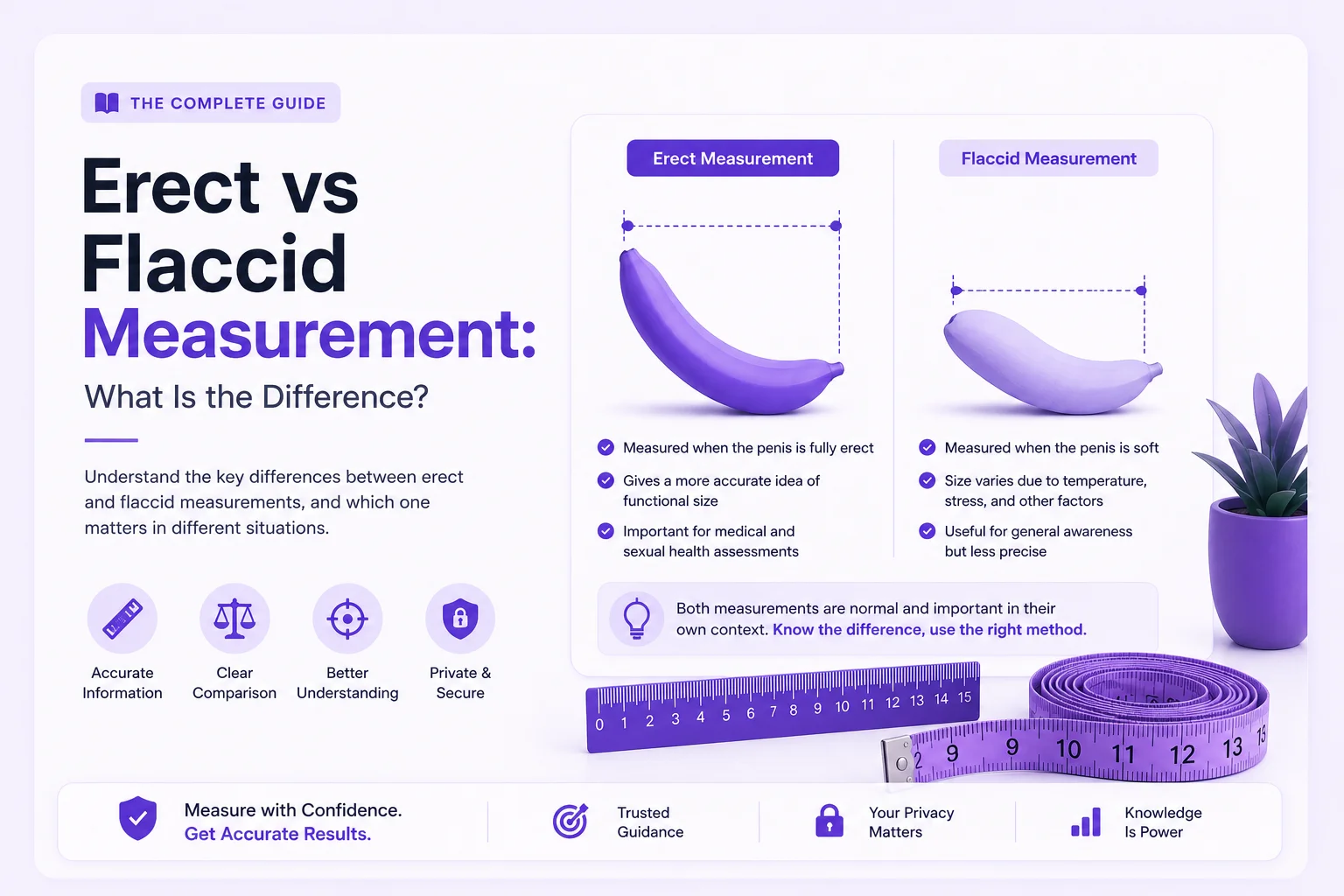
Table of Contents
Erect vs Flaccid Measurement: 5 Easy, Essential Differences
Erect vs flaccid measurement compares the penis in two different physiological states: when it is not erect and when it is erect. Flaccid penis size can vary considerably with temperature, stress, physical activity, and other conditions, while erect length reflects the size reached during an erection. A flaccid measurement alone cannot reliably predict an individual’s erect length.
Understanding the difference helps explain why measurements change, what the terms “grower” and “shower” mean, and why comparing results requires care. The key is to distinguish normal variation from measurement differences and avoid treating a single number as a complete picture of penile size.
Erect vs Flaccid Measurement: 5 Key Differences
The main differences concern the physiological state, the amount of variation, what each measurement can tell you, and how scientific studies interpret the results.
| Difference | Flaccid measurement | Erect measurement |
|---|---|---|
| Physiological state | The penis is not erect | The penis is erect |
| Day to day variation | Often changes noticeably with environmental and physical conditions | May vary with erection firmness and the conditions in which it is measured |
| Length interpretation | Describes length in the non erect state | Describes length during an erection |
| Individual prediction | Does not reliably determine an individual’s erect length | Directly measures length in the erect state |
| Research interpretation | Must be compared with an appropriate flaccid reference | Must be compared with an appropriate erect reference |
These states describe different measurements, not two competing ways to determine which person is larger. A meaningful comparison requires consistent methods and the correct reference data.
What Is Flaccid Penis Size?
Flaccid penis size refers to the length or circumference of the penis when it is not erect. The flaccid state is not completely fixed: a measurement can differ from one occasion to another, even when there has been no lasting anatomical change.
The penis contains erectile tissues that change as blood fills them during an erection. In the non erect state, the amount of expansion is lower, and the visible length can be affected by temporary conditions.
Why flaccid size can change
Several factors may influence the appearance or measurement of a flaccid penis:
- Temperature: Cold conditions can cause temporary contraction, while warmer conditions may reduce it.
- Stress and nervousness: The body’s response to stress can affect how the penis appears in the flaccid state.
- Physical activity: Recent exercise or changes in body temperature can coincide with temporary changes in appearance.
- Arousal and transition between states: The penis may change before a full erection develops or after an erection subsides.
- Measurement technique: Different starting points, positions, and tape or ruler placement can produce different readings.
These factors do not necessarily change the underlying anatomical length. They can influence the temporary appearance or measured length in the flaccid state.
For this reason, a single flaccid reading should not be treated as a permanent measurement or used to make strong conclusions about erect size.
What Is Erect Penis Size?
Erect penis size refers to length or circumference measured during an erection. Erect length is the distance measured along the penis using a defined method, while erect girth is the circumference around the shaft.
An erect measurement is more directly relevant when the question concerns length during an erection. However, it still depends on measurement technique and the degree of erection achieved at the time.
Why erection conditions matter
Erection firmness can vary. If an erection is incomplete, the length and circumference measured may differ from measurements taken during a fully developed erection. This is one reason clinical research may use a defined protocol rather than relying on casual self measurements.
A measurement should therefore be labeled with its state and method. It is not appropriate to assume that every erect measurement in a research paper was taken under identical conditions.
The European Association of Urology’s guidance on penile size measurement describes the use of stretched, flaccid, and erect measurements in clinical assessment and notes that methods vary across studies.
Does Flaccid Penis Size Predict Erect Size?
Flaccid penis size does not reliably predict the erect length of an individual. Although measurements in different states may be related, that relationship is not accurate enough to infer a particular person’s erect length from a flaccid measurement alone.
This distinction matters because a statistical relationship within a group does not guarantee an accurate prediction for an individual.
A study by Wessells and colleagues, published in 1996, prospectively measured flaccid, stretched, and erect dimensions in 80 physically normal men. The researchers reported mean lengths of 8.8 cm flaccid, 12.4 cm stretched, and 12.9 cm erect. They concluded that neither age nor flaccid length accurately predicted erect length, while stretched length had the closest correlation with erect length in their sample. See the study abstract in PubMed.
The study was relatively small and conducted in a particular clinical setting. Its findings support caution about individual prediction; they do not mean that no statistical association can ever exist between flaccid and erect measurements.
Why averages cannot predict an individual result
Averages describe a group. They do not tell you exactly how much a specific person’s penis will change between states.
For example, two people may have similar flaccid measurements but different erect measurements. Conversely, two people may have different flaccid measurements but similar erect lengths. The relationship varies, so the flaccid measurement alone is not a dependable substitute for measuring erect length directly.
It is also important not to calculate an expected personal growth amount simply by subtracting a pooled average flaccid length from a pooled average erect length. Those averages may come from different participants, study methods, and sample sizes.
What Do “Grower” and “Shower” Mean?
“Grower” and “shower” are informal terms used to describe differences in how much penile length changes from the flaccid state to the erect state.
- A grower is commonly described as having a greater increase in visible length between the two states.
- A shower is commonly described as having a smaller increase in visible length, with more of the erect length already apparent in the flaccid state.
These descriptions are convenient in everyday discussion, but they should not be treated as universally standardized medical categories. The amount of change depends on how length is measured and on the definitions used in a particular study.
What did the 2018 study find?
A 2018 study by Yafi and colleagues retrospectively reviewed 274 patients who underwent penile duplex Doppler ultrasound during evaluation for erectile dysfunction. The researchers measured flaccid length before medication induced erection and erect length at peak erection.
Using a 4 cm change as their cutoff, 73 men (26% of the sample) met the study’s definition of a grower, while 205 (74%) were classified as showers. These findings describe that particular clinical sample and the study’s classification method; they should not be interpreted as definitive percentages for all men.
The researchers’ terms were based on the change in measured length, not simply on whether the flaccid measurement looked large or small. Read the 2018 research report in PubMed.
What does newer research say?
A study published online in June 2026 examined 420 men who underwent penile Doppler ultrasound. Using data driven clustering, the researchers identified grower, shower, and intermediate growth profiles.
The study also examined anatomical and blood flow related measurements. The authors noted that the relationship between these profiles and the causes of erectile dysfunction did not reach statistical significance, and that larger prospective studies are needed to validate the findings. The results are therefore an emerging research finding, not a universal diagnostic classification.
The 2026 study in PubMed provides useful context: growth patterns can be studied scientifically, but popular labels should not be used to diagnose erectile function or predict an individual’s health.
Flaccid vs Erect Length in Scientific Studies
Research on penile size often reports separate averages for flaccid, stretched, and erect length. These figures are useful for understanding groups, but the measurement methods and participant samples matter.
A 2015 systematic review by Veale and colleagues developed nomograms from professionally measured data. The review included 10,704 flaccid length measurements, with a pooled mean of 9.16 cm, and 692 erect length measurements, with a pooled mean of 13.12 cm. The sample sizes differed substantially by measurement state. These figures should not be interpreted as a paired comparison showing how much each individual grew. See the 2015 systematic review in PubMed.
A 2025 systematic review and meta analysis included 33 studies and 36,883 participants overall. It reported mean flaccid length of 9.22 cm across 28,201 measurements, stretched length of 12.84 cm across 20,814 measurements, and erect length of 13.84 cm across 5,669 measurements. Again, the sample size differed for each type of measurement. These pooled results are not a record of the change measured in every participant from the flaccid state to the erect state. See the 2025 systematic review and meta-analysis.
Why do published averages differ?
Results can vary because studies use different:
- Participant groups and eligibility criteria.
- Measurement landmarks, such as skin junction or pubic bone.
- Measurement states, including flaccid, stretched, and erect.
- Tools and procedures.
- Clinical conditions and study settings.
- Sample sizes for specific measurements.
The European Association of Urology notes that penile measurement methods have not been standardized universally and that research reports differ in how they collect and report measurements.
For a wider discussion of average measurements and scientific findings, visit Scientific Studies on Average Penis Size.
How to Interpret Your Own Measurements
If you are comparing your own measurements, the most useful approach is to understand what was actually measured rather than trying to fit yourself into a label.
Keep these principles in mind:
- Compare like with like. Do not compare a flaccid measurement with an erect reference value.
- Record the measurement state. Label each reading as flaccid, stretched, or erect.
- Use a consistent method. Differences in landmarks or ruler placement can affect the reading.
- Do not rely on a single flaccid reading. Temporary conditions can change the appearance of the non erect penis.
- Avoid overinterpreting labels. Being a grower or shower does not establish that an erection is healthy or unhealthy.
For detailed instructions on measurement technique, see How to Measure Penis Correctly. For information about repeatability and measurement accuracy, see Accurate Penis Measurement.
After recording a measurement, you can use the Penis Size Calculator to explore the comparisons that its methodology supports. A calculator cannot verify whether the measurement was taken correctly, and it cannot diagnose a medical condition.
When Should You Seek Medical Advice?
Differences between flaccid and erect size are not, by themselves, evidence of a medical problem. Temporary variation in flaccid appearance is common, and the terms grower and shower are not medical diagnoses.
Seek advice from a qualified healthcare professional if you notice a persistent or sudden change that concerns you, pain, a new curvature, difficulty obtaining or maintaining an erection, or another symptom affecting sexual function.
Do not use a flaccid to erect size difference as a substitute for clinical assessment. A healthcare professional can assess symptoms and measurements in context and determine whether further evaluation is appropriate.
Conclusion
Erect vs flaccid measurement compares two different physiological states. Flaccid length may vary with temporary conditions, and it cannot reliably predict an individual’s erect length. Grower and shower are informal terms for differences in length change, while scientific studies use specific measurement methods and definitions that may not apply universally.
The most reliable way to interpret a result is to identify the measurement state, understand the method used, and compare it with the correct type of reference data. Differences between the two states are not, on their own, a diagnosis or a measure of sexual health.
References
- Wessells et al. (1996): Penile Length in the Flaccid and Erect States
- Yafi et al. (2018): Grower or Shower? Predictors of Change in Penile Length
- Veale et al. (2015): Systematic Review and Nomograms for Flaccid and Erect Measurements
- Mostafaei et al. (2025): Systematic Review and Meta-Analysis of Penis Length and Circumference
- García-Gómez et al. (2026): Penile Growth Patterns in Growers and Showers
- European Association of Urology: Penile Size Measurement Guidance
Frequently Asked Questions
1. What is the difference between erect and flaccid measurement?
Flaccid measurement records length or circumference when the penis is not erect. Erect measurement records the same dimension during an erection. They describe different physiological states and should be compared with matching reference data.
2. Does flaccid penis size predict erect length?
Not reliably for an individual. Research has found that flaccid length alone does not accurately predict erect length, even though measurements in the two states may be related within a group.
3. Why does flaccid penis size change?
Flaccid appearance can change with temperature, stress, physical activity, arousal, and other temporary conditions. These changes do not necessarily mean that the underlying anatomical length has changed.
4. What does “grower” mean?
A grower is an informal term for someone whose measured length increases substantially between the flaccid and erect states. The exact threshold depends on the definition used; there is no single universal cutoff that applies to everyone.
5. What does “shower” mean?
A shower is an informal term for someone whose measured length increases less between the flaccid and erect states. The term describes a pattern of length change, not a diagnosis or a judgment about sexual health.
6. Are growers and showers official medical categories?
The terms appear in research, but classification methods vary. A 2026 study identified grower, shower and intermediate profiles using data driven clustering in a clinical sample. More research is needed before such classifications can be treated as universal clinical categories.
7. Is stretched length a better predictor of erect length than flaccid length?
In the 1996 study by Wessells and colleagues, stretched length correlated more closely with erect length than flaccid length did. This is a study specific finding and should not be interpreted as an exact prediction for every individual.
8. Why do average flaccid and erect lengths differ across studies?
Studies may include different participant groups and use different measurement landmarks, methods, states, and sample sizes. Pooled flaccid and erect averages may be based on different sets of participants, so they should not be treated as paired measurements.
9. Should I compare flaccid length with an erect size percentile?
No. Compare a flaccid measurement with an appropriate flaccid reference and an erect measurement with an appropriate erect reference. Using the wrong reference can lead to a misleading interpretation.
10. Does being a grower or shower indicate erectile dysfunction?
No. The label alone does not diagnose erectile dysfunction or confirm normal erectile function. If you have persistent erection difficulties, pain, or other symptoms, discuss them with a qualified healthcare professional.